(This is the fourth of a nine-part installment, offering a fresh new perspective on Climate Change. For the big picture summary, see Turning Climate Change on its Head.)
Humans are unlike any other species in the knowable history of our planet. Our self-consciousness and incredible mastery of knowledge and collaboration collectively power a myth that the first two laws don't apply to us - that we can control our propagation and resource consumption, and that we are immune from nature’s feedback mechanisms. This turns out to be false under our current paradigm.
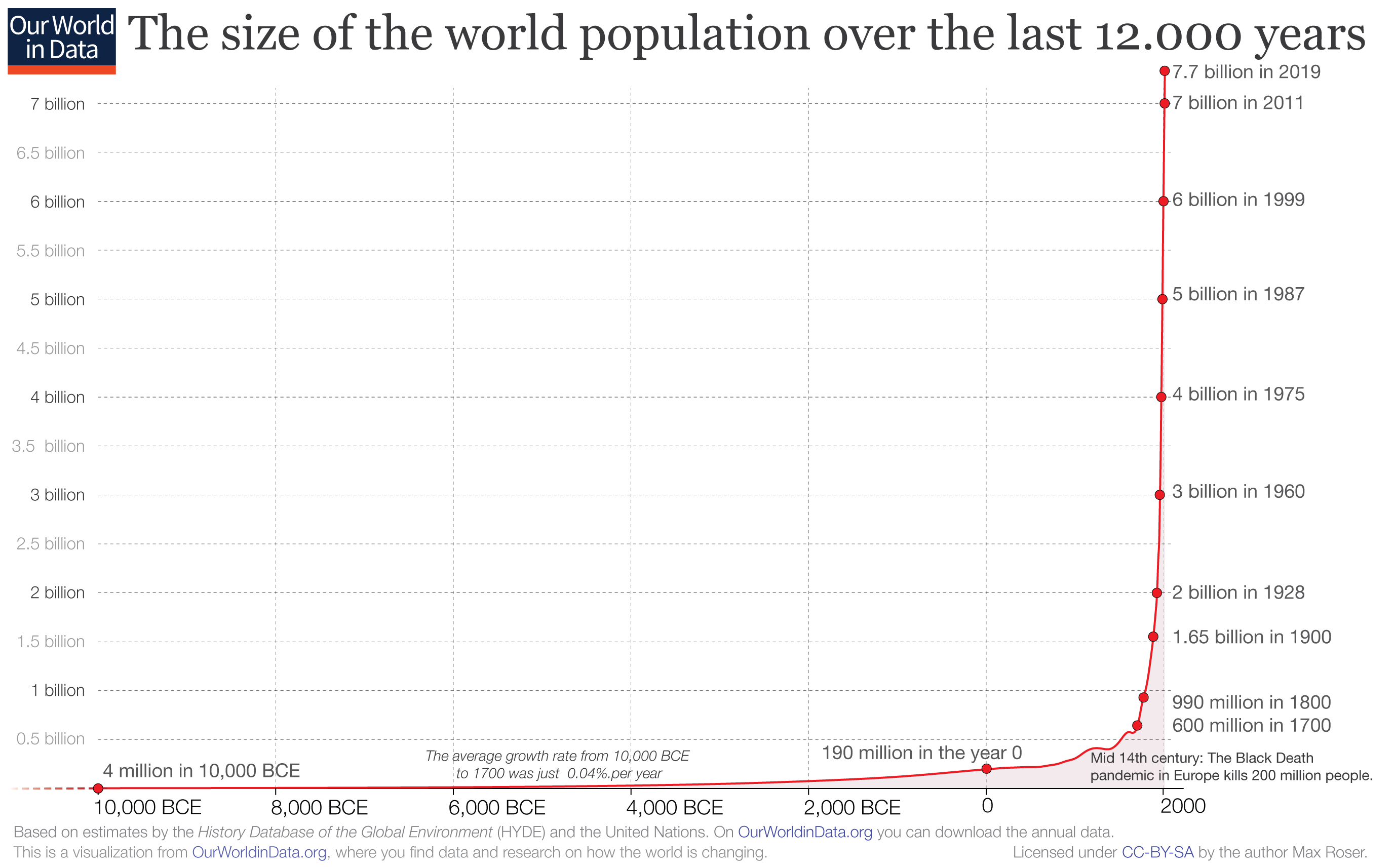
I can't prove that humans have insufficient self-control and lack immunity from the laws that I described in parts 2 and 3. However, I think I can provide some fairly compelling evidence that this is so.
Population Growth
Yes, if we use the base goal of propagation as our measuring stick, there's no question that humans have been wildly successful, as demonstrated by the graph above. (By the way, that graph goes much further to the left, and stays just as flat.) And yet, one would be hard-pressed to find a single human who believed that our planetary home or our prospects for a successful future are in any way improved by our explosive growth in numbers. Moreover, we have convincingly known this for at least two generations. In that time, we have developed cheap and effective birth control, reduced birth rates through education and empowerment, and even imposed restrictions of family sizes. The fact that our birth rate has declined moderately in the last 50 years suggests that we can indeed control it. However, our actual population in the same period has doubled. The basic math tells us that the way things are going, it will be a long time before that kind of declining birth rate has any appreciable effect on our crippling problem of overpopulation. Our biological imperative to propagate still rules.
Consumption Control
I can't argue that humans don't have the potential for resource consumption control, but our history is littered with evidence of societies not exercising it. From the tribal groups that drove thousands of bison over cliffs in order to consume just a few, to the peoples who cut down the very last tree on Easter Island, and even to the trawlers which now empty our seas of precious fish stocks and ranchers who burn down the rainforests - we refuse to see nature's bounty as finite.
One factor working against any practical application of self-control is our modern definition of value, where scarcity drives value higher. We therefore doubly profit by harvesting most of nature's riches within our own lifetime. It is true that we have applied our amazing intelligence to introduce remarkable efficiency in our productivity, but efficiency has never been used to reduce consumption - it invariably increases consumption at greater profit. Like every other living thing, humans make maximum use of available resources. The only difference our brains make is that we can consume to deadly effect.
Irrational Species with Flawed Values
Yes, humans are incredibly smart and self-aware, but, as Bill Rees points out (as his first premise), we are not rational creatures. He says: "passion and instinct often trump reason, particularly in times of crisis". Worse yet, even when we are supposedly being 'rational', our Modern Techno-Industrial civilization has adopted quantity as its predominant value system. When value is quantity, then More is Always Better. As a consequence, our rationality is exercised within a value system which has no concept of peak sufficiency - within a natural world where absolutely everything incorporates the concept of peak sufficiency as an imperative.
We run our Modern Techno-Industrial civilizational using 'economic principles', based on mathematics, that only work in an unreal world, based on a false assumption of all humans as rational agents within a system of simple rules and calculations. Our ability to alter the impacts of our reality has led us to believe that we can alter reality itself. Again, to borrow from Bill Rees, "human beings 'socially construct' their own realities. More accurately, we construct social lenses through which we perceive reality (e.g. political ideologies, religious doctrines, scientific models, economic paradigms, cultural narratives, etc.)" As a result, "the conceptual lenses through which we perceive reality determine the kind of reality we perceive." We are no longer able to be objective observers of what we are doing to our environment - we only see a tiny keyhole view of what we choose to look at and be aware of. Thus, we are able to create the Myth of Self-Control and Immunity.
Failing at Improving Nature
There is no question that the belief in humanity's control over nature and immunity from its laws is widespread. As a result, we act, and act quickly, whenever we see an opportunity to supposedly improve on nature and bend it to our will. Our history is clogged with ever-increasing instances of where that behaviour has backfired with dramatic effect, climate change being simply the latest. We wipe out entire species, with no understanding of the impact that removing key components from the complex network of life will have on the entire system. We voraciously alter the landscape with our sprawling cites of pavement and concrete, and our decimation of entire ecosystems in search of more resources to consume. We poison our world with biologically-indestructible plastics and lethal new chemicals, with only the tiniest of guesses on their long-term impacts (if we even care to consider them). We commit, all in, to these virtually untested technologies, and make irreversible decisions based on profit over survival. We think we can do better than nature's billions of years of trial and error and system evolution. At best, we fool ourselves with short-term gains, only to fail spectacularly for the long-term. Every time.
Common Heuristics for Negative Feedback
The best negative feedback against uncontrolled population growth and other problematic behaviours is not harsh environments like extreme cold or the pressures of the ocean floor. We already know that, given time, life can adapt to those challenges and even thrive there (as humans can do. Humans are not unique in that respect - the only difference is that instead of physically evolving for such environments, we evolved the intelligence to deal with them, allowing us to transition much faster than if we had relied on changes to our physiological design.)
No, the best negative feedback comes in two forms: Changes that happen faster than the species can adapt to them, and (in its purest form) reactions that are a direct result of the unwanted actions (and correspondingly scalable). Generally speaking, change in nature does not happen very quickly. The most common changes, like the seasons, are predictable and the cycles themselves rarely change, allowing species to adapt and thrive.
As mentioned, the most efficient negative feedback is undesirable outcomes driven directly by the actions of the species, such as starvation due to excessive population growth with limited food sources. The greater the population boom, the more depleted the food sources and the more catastrophic the effect on the species.
Conclusion
From the characteristics discussed above, climate change is particularly well categorized as negative feedback. Even though its progress seems pretty slow to us, the localized effects like forest fires, floods, mega-storms, and even sea-level rise are happening faster than humans and human infrastructure can move out of the way. More importantly, the effects of climate change (and their severity) are directly attributable to our own actions - there is no doubt of that anymore.
No one can dispute that humans have significant self-awareness and impressive self-control - as individuals. However, our impacts are now significant enough that they are subject to nature's most powerful complexities - systems that we cannot begin to fully comprehend. Humans, as living organisms, are not immune to the Law of Propagation and Consumption, and while our intelligence has given as a huge advantage over some of nature's minor limiting factors, we are clearly still subject to the potentially fatal Law of Negative Feedback - even feedback of our own creation.
(Continue to part 5 of 9)

