I recently wrote a multi-part series about Turning Climate Change On Its Head. In this post, I will try to reduce the essence of that series to 30 statements, and a controversial conclusion. I am dispassionately following the facts where they lead. You tell me where the logic might be questioned.
The Aanimad Assertion on Climate Change
[It seems that even a single blog post can run a little long for some, so I have added a three-statement summary of my assertion:
A. Given that life is predicated on growth, biosustainability REQUIRES negative feedback.
B. Fossil fuels and number-based value systems have resulted in humans neutralizing nature's usual negative feedback mechanisms.
C. Climate Change IS the missing and required negative feedback.
What follows is the detailed derivation of this assertion.]
2. The vast majority of current human-generated CO2 production is caused by the burning of fossil fuels, which has exponentially increased because of civilization’s exponentially increased use of fossil fuels to provide energy.
3. The energy from fossil fuels has been used to power massive leaps in human technology, survival, and standards of living, including the ability to live in relatively inhospitable climates and to provide food for a hugely growing population.
4. All living things are characterized by a drive for growth and propagation. Without such imperatives, any species would soon disappear from the biosphere. Humans are no different.
5. The natural control for unfettered exponential growth of any one species is negative feedback. ["Negative" does not describe good or bad. It is used in the scientific sense, as in "feedback in opposite phase with (i.e. decreasing) the input".] Negative feedback is a necessity for sustainable systems. [In this case, "sustainable systems" refers to the dynamic balance required to allow a species population to continue to exist.]
6. Negative feedback occurs in two forms: kind and unkind. Kind negative feedback includes concepts of peak sufficiency, where the organism chooses to alter a behaviour. ["Peak sufficiency" refers to the peak value, after which more would not be desirable. It is a maximum, not a minimum.] Unkind negative feedback includes impacts such as resource shortages, disease, and conflict, which almost invariably arise as a direct result of the growth itself.
7. While physiological concepts of peak sufficiency (as applied to food, sleep, warmth, etc.) have not changed for humans, our knowledge and understanding of science have progressed to the point where, combined with the awesome energy of fossil fuels, we are able to circumvent many of nature’s unkind negative feedback mechanisms, such as disease, food scarcity, and habitat limitations.
8. Having apparently bypassed nature’s unkind negative feedback for population control, humans have followed the natural drives of any species for growth, propagation, and maximal use of all available resources.
9. The rise of agriculture transformed our required food inputs from things found in nature to (mostly) things managed (and therefore ‘owned’) by humans.
10. Since humans no longer felt totally vulnerable to the influence of nature, and saw its resources as boundless, they developed human-centric economic paradigms, independent of natural linkages, consisting predominantly of producers and consumers, where nature’s bounty was simply a given.
11. It is suggested that the evolution of agriculture, trade, and ownership led to increasingly sophisticated numeracy skills, and societies where numbers were used to measure wealth. For example, trade led to the introduction of some form of money, and ownership led to counting what is owned. From this arose number-based values, which are different from our innate qualitative values.
12. Number-based values are measures where more is always worth more. Since numbers are limitless, wealth measured by number is such that More is Always Better, and the negative feedback concept of peak sufficiency does not apply in number-based value calculations.
13. Having removed the concept of peak sufficiency from our predominant measure of wealth, humans eventually created entities (business corporations) who embodied number-based values exclusively, leveraging the intrinsic positive feedback loops of numbers, without being subject to the mortal filters of human qualitative values or even the limitations of human life spans.
14. Adopting value systems which have no concept of peak sufficiency (i.e. kind negative feedback), while bypassing nature’s unkind negative feedback, results in an unsustainable way of life for our species. (See 5.)
15. Exponential growth of human population and technology transpired over a time that was not long enough for the natural world to evolve adaptations for the changes or processes to deal with the inevitable waste products of exponentially increasing economic activity.
16. As civilization is something that happens with physiological beings (who must live within nature’s complexity on a finite planet), any economic model that does not account for nature’s inputs and waste management is fatally flawed. (See 10.)
17. One important fundamental need of economic activity and human survival is energy. Fossil fuels continue to provide the vast majority of cheap energy, so their exponential consumption is tied to exponentially growing economic activity.
18. One impact of relentless economic activity expansion and population growth is (1) anthropogenic climate change. Other direct impacts include (2) freshwater withdrawals, (3) nitrogen/phosphorus loading, (4) land conversion, and (5) biodiversity loss.
19. Being disconnected from nature, the neoliberal economic models did not effectively address waste management, resulting in (6) chemical pollution, (7) ocean acidification, (8) air pollution, and (9) ozone layer depletion.
20. The nine impacts listed above are collectively known as Ecological Overshoot. Climate Change is only one of these serious threats to human civilization and the continuance of our species. This combination of multiple looming disasters is where the term “polycrisis” originates.
21a. Human civilization got to this point because we adopted a predominant measure of wealth that had no concept of peak sufficiency (reducing the influence of natural kind negative feedback on our consumptive behaviours), and we circumvented nature’s typical unkind negative feedback (which controls population growth). (See 8 and 12.)
21b. This is not to say that we abandoned our core qualitative (human) values (like justice, compassion, beauty, joy, integrity, etc.). Those are hardwired into our brains. However, we have allowed those values be consistently trumped by number-based values, and created powerful entities (corporations) that do not recognize our human core values. (See 13.)
22a. Our current economic model of More is Always Better, combined with the absence of integration with concepts of finite resource and waste management, can be directly tied to all nine components of Ecological Overshoot.
22b. I refer to this situation (where one factor is a key cause of the polycrisis of Ecological Overshoot) as our Value Crisis. The idea that one factor might be at the root of a polycrisis is where the term “metacrisis” originates.
23. Given that we are in a polycrisis, solving, mitigating, or adapting to Climate Change will likely have minimal impact on any of the other major threats of Ecological Overshoot.
24. However, addressing the metacrisis and correcting the basis of our economic values could indeed mitigate and potentially reverse all of these nine threats listed above.
25. Recent evidence suggests that humanity will not voluntarily comprehensively correct its current way of life and the economic values that underpin that. I suggest that we are unable to solve the metacrisis on our own. (See, for example, The Value Change Conundrum.)
26. Any serious attempt to correct our flawed economic values will be vigorously opposed by the massive forces that derive their wealth from those values.
27. Still, Climate Change poses a serious threat to our current way of life. It is popularly the most pressing (and increasingly visible) threat to our economic activity.
28. Climate Change therefore constitutes one of nature’s most powerful negative feedback mechanisms to the economic values that caused it.
29. The other aspects of Ecological Overshoot will not be far behind, and will have similarly disastrous consequences for human civilization.
30. Unkind negative feedback is never desirable to the targeted species. We are therefore highly motivated to resist it. However, the negative outcomes of our poly/metacrisis for the human race are similar, whether Climate Change is ‘solved’ or not.
Concluding Assertion:
a) The
impulse to demand action on mitigating the effects of Climate Change is inevitable
for human nature, but that action will not dramatically change the prospects
for civilization and our species. (See
26, 29, 22, 24, 25 and 28.)
b) On the contrary, given that Climate Change could be the force needed to break humanity out of its flawed economic values, the sooner that happens the better, before the effects of the other aspects of Ecological Overshoot become irreversibly fatal. (See 24, 27, 21, 23, and 28.)
c) Climate Change could well be a major part of the solution to our metacrisis. Our primary focus should be on restoring some precedence of qualitative values to be adopted after systems which rely exclusively on number-based values are no longer working for us, and how to minimize the damage from that transition.
d) Rejecting the unquestioned precedence of number-based values, acknowledging our interrelationships with nature, and rethinking the definition and role of commercial corporations could be enough to redirect civilization towards a sustainable model. (See 21, 16, 13, and 5.)
Disclaimer:
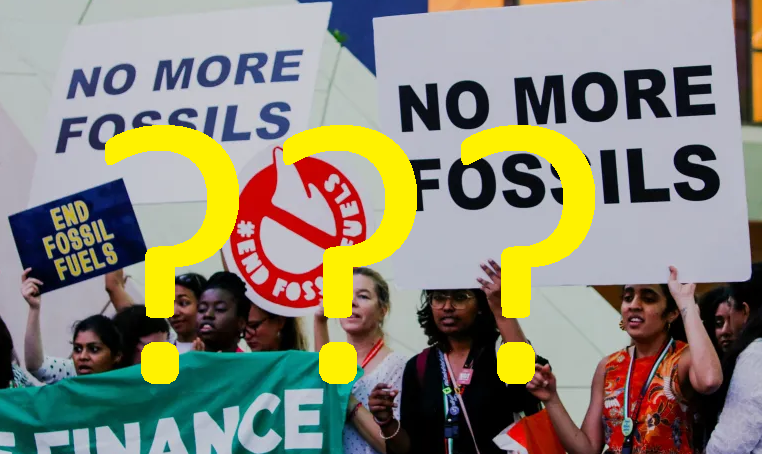
?
- Am I opposed to citizens demanding action on Climate Change?
No,
but only so long as there is a realization that the real challenge is the
causal value system underpinning Climate Change. Our compassionate instincts insist that we do
our best to combat the destructive impact of fossil fuel burning, however, I do not accept that any
significant gains will be made in the attempt.
If
explicit by-products of any climate change action include an increased
awareness of the root cause of our multi-part polycrisis (that being a flawed value system), and greater acceptance of our true
role within the biosphere, then I have to support that.
If,
on the other hand, the proposal is that we can somehow continue our current
behaviours and economic model simply under an alternative energy source, then I
oppose such delusional thinking.
I also oppose the demonization of the fossil fuel industry. Those corporations, like all commercial corporations, are acting precisely in the manner that society programmed them and continues to demand them to.
Support for The Aanimad Assertion on Climate Change:
The following scientists and progressive thinkers have signed on as supporters of this Assertion:
John Maskell, PhD - Brockville, ON
Member, Canadian Association for the Club of RomeRuben F.W. Nelson - Calgary, AB
Executive Director, Foresight Canada
Member Emeritus, Association of Professional FuturistsMike Nickerson - Lanark, ON
Seventh Generation Initiative
Member, Canadian Association for the Club of Rome
Author of Life, Money & IllusionAndrew Welch - Alton, ON
Member, Canadian Association for the Club of Rome
Author of The Value Crisis

