Showing posts with label labour. Show all posts

Friday, February 12, 2016

The Mystery of the Uncomfortable Barter

One of the truly wonderful things about The Value Crisis discussion groups and speaking engagements is that my perspective gets challenged by intelligent people struggling to apply the concepts to everyday life.  One such magical moment arose this week, when a participant in our chapter-by-chapter exploration of the book gave us a perplexing anecdote to puzzle out.  Let me first set up the context...

We were discussing Chapter 3 (Money - The Number Culture), which includes a brief history of money, from the days of barter through to today's banking databases.  One of the propositions of that chapter is that the barter of goods or services between two willing participants is always a win-win transaction.  Both sides are getting something they want, and either employing a skill that they already have or giving something that they want less - hence the net value of both sides goes up.  Such an exchange feels quite different when you instead look at two separate transactions that use money to quantify the value.
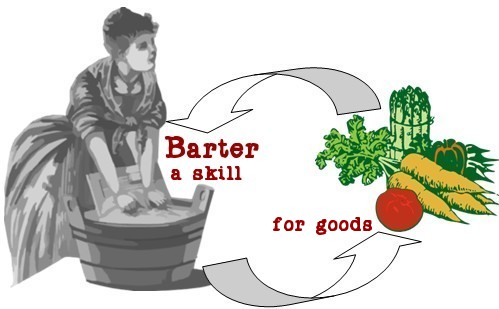


Barter actually capitalizes on the concept of marginal value.  This economics term is used to convey the idea that the 'value' of a particular thing (to us) depends on the quantity of that thing that we already have.  If I have hundreds of arrowheads, their marginal value to me is low, but if I have no baskets, the marginal value to me of a needed basket would be quite high.  I would be very willing to trade a few arrowheads for a basket.  Barter works when I find someone with many baskets (each therefore having a low marginal value for them), who needs an arrowhead or two.

So back to our story.  The reader who shared the anecdote is an organic hobby farmer of sorts.  She keeps a variety of livestock and is an enthusiastic promoter of permaculture practices.  As she relates it, she had an experience where the long hours of back-breaking farm work had taken its toll and she wanted to get a massage.  She had met a masseuse who was open to providing such a service in barter for some of the meat that the farmer raised on her land.  Learning that the typical price for the service was $80, she gathered up $80 worth of organic beef and went in for the relaxing treatment.

Alas, afterwards, she was disappointed by how she felt about the transaction.  Perhaps while in the midst of having the knots removed from her back, she was thinking about all the hours of work that had put them there: looking after her stock day after day, mucking out stalls, and hauling buckets of food for the grain-fed beef.  And, in exchange for a significant portion of the end gains, she was getting perhaps less than an hour on a massage table.  It didn't feel right.

This struck a chord with me.  In a later chapter (Ch. 5 - The Value of Time), I talk about how difficult it was for me, as a newly self-employed person, to set a billable value for my time.  I might do a day's work with community not-for-profits for $100, and then do the same work for a large corporation and bill more than ten times that amount.  So what was the true value of my time?  What should I bill clients who fell in between those extremes?  Was it right that the client's budget always determine my fee?  How could I determine if a particular project remuneration was "worth my time"?

My ultimate solution was how I felt about my contribution and corresponding compensation.  If I felt I was being taken advantage of (or was taking advantage of someone else) I felt bad.  Otherwise, I would consider the project a fair transaction.  The numbers played no direct role.  Now here was this woman voicing a familiar reaction:  the massage-for-beef transaction didn't feel right.  But this was barter!  So what went wrong?

Most people initially see the disconnect in terms of the time differences.  Farmers work long hard hours to grow, maintain, harvest, and prepare their produce for consumption.  And here was my friend, trading a chunk of that for a service that was provided in a tiny fraction of that time.  I agree that this would certainly be an influence.  However, quantifying time and worth is full of all kinds of pitfalls.  There are so many added variables.  A dentist charges not just for the half-hour of teeth work, but also the training, capital costs of the office, etc.  Part of a masseuse's fee has to take into account that they don't usually work full 8-hour days.  Nor can they leverage economies-of-scale to massage more than one client at a time, the way a farmer might be able to double their herd with minimal additional effort and overhead.

No, upon reflection, I think something much more interesting happened to this transaction.  The clue is the $80 value.  The reader had looked up the posted value of the massage and then tried to put together a package of food that had the same monetary value.  To me, that is not really barter.  That is simply a transaction, using prices on both sides, that happens to use meat as a currency.  Marginal value was no longer a key component of the feelings of value and worth.  Instead, both players reverted to the quantified market value, which completely alters the quality of the relationship.  As soon as the numbers come in, the barter doesn't even have to take place for the farmer to feel disappointed.  She could simply contemplate how she had just paid $80 for a massage and then later think about how much work had gone into a totally separate sale of $80 worth of beef.

That's the thing about numbers and number-based values.  They allow us to do things like instantly compare our salary to that of our spouse or a co-worker or a professional baseball player.  Or compare a season of livestock management to a spa treatment.  Such pursuits often to lead to bad feelings, no?

Friday, March 13, 2015

The Village Against the World

Today, a reader shared a fascinating article on what they captioned "One solution to the Value Crisis??".  The article was an edited extract from Dan Hancox's book "The Village Against the World".  To put this post into context, you really have to read the article itself, printed in The Guardian in October, 2013.

In a nutshell (from his website), Dan's book is the story of the villagers of Marinaleda, Spain, "who expropriated the land owned by wealthy aristocrats and have, since the 1980s, made it the foundation of a cooperative way of life.  Today, Marinaleda is a place where the farms and the processing plants are collectively owned and provide work for everyone who wants it.  A mortgage is €15 per month, sport is played in a stadium emblazoned with a huge mural of Che Guevara, and there are monthly 'Red Sundays' when everyone works together to clean up the neighbourhood.  Leading this revolution is the village mayor, Juan Manuel Sánchez Gordillo, who in 2012 became a household name in Spain after heading raids on local supermarkets to feed the Andalusian unemployed."

Of course, accepting what they have done Marinaleda seems to sanction anarchy and lawlessness.  When you adopt a value system which is contrary to that upon which most of the laws around you are based, those terms are the ones that most easily come to mind.  However, while that is certainly the context, I would like to look at some of the principles being put forward.  The article, being a brief extract, is not very detailed, but three specific characteristics of their model are highlighted:


"Land belongs to those who work it"

In my opinion this is an unfortunate wording of an even grander ideal.  Personally, I believe that land should belong to no-one.  The concept of personal territory is one thing - it occurs throughout nature.  But owning land?  Especially land that you might never have set foot on?  Buying and selling something that was not in any way produced by us?  I prefer our millennia-old tradition of the humans belonging to the land, not the other way around.  What the villagers are really saying (in my preferred interpretation) is that the output of the land - the food - should belong to the people who put the effort into growing it.  And why should it be any other way?


"Everyone in the co-op earns the same salary"

This does not mean that everyone contributes the same amount, or even that everyone necessarily deserves an equal share.  This (again in my personal interpretation) acknowledges the fact that even Marinaleda exists within a system where, to provide the basic necessities of life, one must have money.  They have not yet eliminated that concept from their society (even if they could).  Working from that, it is relatively safe to say that all of the residents have the same basic needs of food and shelter, and so the same salary should cover those for each person.  When money is being used to satisfy basic needs, as opposed to being a determinant of what value people are bringing to the community or how much their individual skills and talents are worth, then it takes on a whole new meaning.  If you can stop measuring happiness by wealth, then the concept of equal salaries becomes fairly benign.


"Our aim was not to create profit but to create jobs"

Face it, if everyone has the money they need to buy what they need for a good life, what do they need next?  They need something to do.  They need to be able to contribute to the greater good of the community (and thus their own well-being).  I choose to believe that this is not about choosing labour-intensive crops as a make-work lifestyle so that everyone can make money.  It is about maximizing the resource that you have (labour) so that people can pursue other pleasures without it being at the expense of their neighbour's happiness.  At some level, the pursuit of efficiency crosses over the line from working smarter to catering to a very specific set of values (at the expense of more important values).  As many non-industrial farmers will soon tell you, there is a joy and connection that comes from working the land - from growing and eating your own food.  As it is everywhere with the idea of repairing things, when we stop seeing labour as an evil to be minimized, we learn to find the time to make better, more respectful choices of how to manage the resources that this planet provides to us.  We produce durable, esthetically-pleasing goods.  And we also discover a surprising level of satisfaction from developing the skills to feed ourselves and maintain the items that are important to our lives.


What should be most interesting is to see how Marinaleda fares in the worsening economic crisis that Spain now finds itself in.  It may not be long before your own 'village' is facing the same dilemma.  It is challenging to be a qualitative-value island in the middle of a quantitative-value ocean.  However, that particular ocean is not actually very deep.  Money only has power and value as long as we believe it does.  If the population loses that belief, the value of money vanishes, and that could actually happen overnight.