Monday, November 28, 2022

#5a - Impossibility of Effective Climate Change Action?

(This is the sixth of a nine-part installment, offering a fresh new perspective on Climate Change.  For the big picture summary, see Turning Climate Change on its Head.)

Either effective action to halt or mitigate climate change is possible, or it’s not.  Let’s consider both options, starting with the second.

Climate Change is already well underway.  (Check out one of the best, very short videos I've ever seen to make this point.)  There’s a belief that what’s needed is serious political or corporate will, but I suggest the reality is that our predominant societal value system simply cannot accommodate the required actions.  If we also accept the inevitability of the law of consumption, and the fact that immunity from consequences is a myth, climate change WILL be in our future.
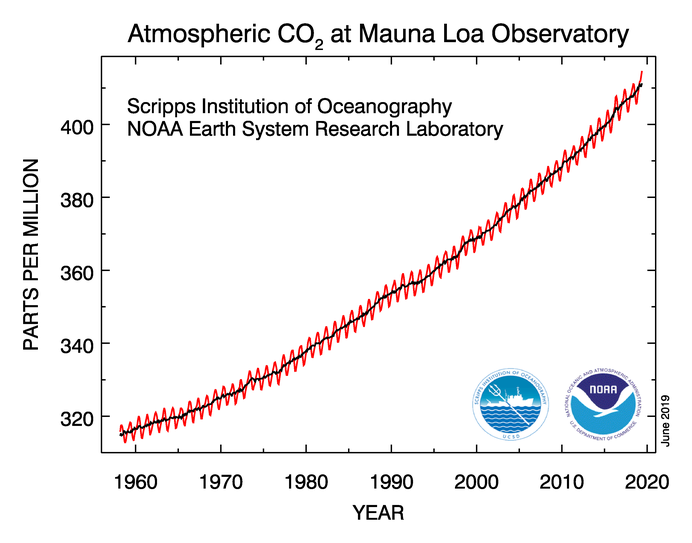
COP1 happened in the middle (1995),
followed by COP2 through COP27.
Note the absence of any change to trajectory.

I'm not going to hide my bias on the question of whether or not humankind is going to have any kind of significant impact on climate change.  This post is intentionally one-sided, because I will argue the opposite case in the next part.

History and Scope

Let's look at the history here.  We just wrapped up COP27.  COP stands for Conference of the Parties and will be attended by countries which signed the United Nations Framework Convention on Climate Change (UNFCCC) - a treaty agreed in 1994.  28 years ago.  We have had 27 annual meetings to implement some actions since then.  And nothing meaningful has happened.  Nothing.  No one is even close to on track for promised targets, and the best outcomes just reached this year were some adaptation measures and an agreement to pay for some of the damage.  In other words, it looks like the participants are sort of assuming that climate change is now a done deal.  And the science tends to agree with that.

The scope of what would have to be undertaken now in order to make the slightest dent in climate change impacts is staggering.  And we recently got proof.  The best movement towards UNFCCC targets happened during the worldwide lockdowns inspired by the CoViD-19 pandemic.  Those changes to the level of economic activity are good illustrations of the tip of the actions-required iceberg.  And how well did we do with those?  Effective mitigation would likely require many more years of a similar scope of change.  Only bigger and lasting much longer.

Follow the Money

There are some who believe that this is a simple case of having the political and corporate will to make the changes necessary.  The actual driving forces in those two sectors are simple and widely recognized - stay in power and make a profit, respectively.  For the politicians, it is not just the case of waiting until enough people demand effective action - they also know that the electorate is not going to like the side effects of those actions.  Everyone wanted the pandemic to go away, but very few were long-term supporters of the measures required.  As a result, the governments bounced back and forth between healthcare and economic priorities - a strategy that helped create the multiple waves of pandemic surges.

My personal guess is that climate change action will follow the markets, just as it does now.  Up until this point, the money has been on climate change denial and ignorance (as in "ignoring"), because economies running at full speed is where the profit is.  As the world's population begins to get behind the climate action movement, a great deal of money will be made by corporations selling 'solutions' that are not really going to do much.  The temptation will be to apply economic solutions to a problem for which economic activity is the problem.  It won't work.

The Value Change Conundrum

Truly effective climate change action, in my books, calls for changes to which value systems take precedence in society.  Changes to the priority of value systems are tricky because people have to get past what I call the Value Change Conundrum.  It works like this:

You won't change your predominant value system until you see the benefits for doing so.
And yet the benefits may only be apparent after you have made the change. 

For example, if someone suggests that you should put more emphasis on organic eating, but you are presently focused on money, then you might never grasp the benefits of organic eating because the price of organic food is a significant downside under your current value system.  If the money is presently the most important thing, why would you choose to switch to a set of values where you will lose money?

In terms of climate change action, the costs of mitigation attempts will likely be significant in jobs, convenience, standard of living (quantity of stuff), GDP, etc.  Many people will suffer great hardships.  Who would choose this?  Especially, when many of the decision-makers are what I call NIMPLEs (Not In My Personal Life Expectancy).  They figure they may never see the benefits of their 'sacrifice' (as seen from their existing value system), so why do it?

The Facts

Here are the facts, as I see them:

  • The global population will continue to rise, unless taken out by catastrophe.
  • The lifestyle changes needed to reduce consumption and energy will not happen voluntarily.
  • Economic forces will oppose effective climate change action at every turn (because they have to).
  • Even the richest nations cannot duck the climate change forces coming in ever-increasing strength.
  • At best, COP28 through 40+ will continue to look at simply paying off the most climate-vulnerable.

In short, I don't think our civilization will achieve effective action against (or to seriously mitigate) climate change in time to avoid the most serious consequences.  I suggest that there are much better things we could be doing with our time and energy right now, in order to ensure the best possible outcomes for our species.

Admittedly, many would consider that a harsh reality, so if you disagree with that prognosis, let's consider the opposite one in the next part.

(Continue to part 7 of 9)

Saturday, November 26, 2022

#4 - The Complex Crises of Current Reality

 (This is the fifth of a nine-part installment, offering a fresh new perspective on Climate Change.  For the big picture summary, see Turning Climate Change on its Head.)

Human ingenuity and technology, combined with our unnatural quantitative value system, have ultimately led to multiple complex crises that directly threaten civilization as we know it.  They include climate change, the Sixth mass extinction, resource scarcity, global poisoning, food insecurity, pandemic diseases, uncontrolled technologies, nuclear arms, overpopulation, and untenable social inequity.  These have been collectively described as ecological overshoot.  While there is no question that these crises are connected, solving any one of them will not solve the others.


The understanding that our present civilization is facing unprecedented multiple, simultaneous, globally looming disasters is becoming increasingly widespread, as indicated by new terms emerging in the media, such as meta-crisis and polycrisis.  Here's a quick word on each (and there are more than are listed here):

climate change - The warming of the planet through the effect of human greenhouse gas emissions; already well-underway.

the Sixth mass extinction - A massive extinction of a high percentage of biodiversity; the previous one occurred 65 million years ago, wiping out the dinosaurs; this one is due to human activity.

resource scarcity - Resources for life and the products that we make are all being consumed faster than nature can replace them, including fossil fuels, fish stocks, and even clean air; also includes resources where the easily-accessed deposits have long since been taken, meaning more energy is required to find new stocks.

global poisoning - Human activity can result in poisons like lead showing up in unnatural places, or new poisons like pesticides and micro-plastics getting into biological systems with potential lethal (or long-term unknown damaging) effects.

food insecurity - A worsening lack of access to good, healthy, and culturally appropriate food; effects range from unhealthy populations living in constant stress to mass starvation.

pandemic diseases - Hardly need to say much on this except that CoViD-19 was not the first and there will likely be a shorter gap until the next.

uncontrolled technologies - This encompasses any of a number of scenarios where technology runs out of control; it could include artificial intelligence, but it might also cover overreliance on algorithms for social functioning and social media run amok.

nuclear arms - The war in Ukraine serves as a reminder that the threat of nuclear devastation or annihilation is sometimes only one madman away, not to mention the risk of nuclear deployment by error or non-state players, as systems and structures break down.

overpopulation - While this speaks for itself, other factors will include mass migrations of existing populations, as they leave areas of conflict and environmental disaster.

untenable social inequity - The gap between rich and poor is not only widening to unimaginable gaps, the number of people at the very top of the wealth pyramid is also shrinking; with private armies and huge swaths of humanity living in poverty, it is only a matter of time before this inequity explodes into conflict.

While there may be good arguments to show why these multiple disasters all appearing at the same time is not random coincidence, there is no apparent common addressable cause.  (I have my own value system theories which we don't need to get into here.)  Similarly, while some of their roots and effects are linked, many are not.  It is difficult to see how solving the threat of nuclear war and the arms race would impact global pandemics, or how untenable social inequity is directly related to our poisoning of the global environment.

The key takeaway from this section is simply this:

Solving any one of them will not solve the others.

Since climate change is currently high on our societal awareness barometer, let's start there.  Consider some actions that might be needed to mitigate or resolve climate change:

  • increased adaptation to extreme weather effects
  • reduced dependence on fossil fuels
  • lowering resource consumption
  • economic restructuring to discourage harmful activities
  • switching to alternative energy sources

How would any of these effectively resolve pandemic diseases, uncontrolled technologies, nuclear arms, overpopulation, and untenable social inequity?

On the other hand, consider the effort that might be required to tackle such a massive worldwide challenge as climate change.  Will there be any energy, focus, or resources available to tackle any of the other multiple pending complex crises?  Not a chance.

That said, the very real impacts of climate change on our personal lives, right now, and the growing (and late) worldwide response, give this particular crisis special status.  It is the role of climate change that we will look at next.  I can't say for certain whether climate change mitigation or adaptation is even possible to the extent required, or not, but we will consider both possibilities.

(Continue to part 6 of 9)

Friday, November 25, 2022

#3 - The Myth of Self-Control and Immunity

 (This is the fourth of a nine-part installment, offering a fresh new perspective on Climate Change.  For the big picture summary, see Turning Climate Change on its Head.)

Humans are unlike any other species in the knowable history of our planet.  Our self-consciousness and incredible mastery of knowledge and collaboration collectively power a myth that the first two laws don't apply to us - that we can control our propagation and resource consumption, and that we are immune from nature’s feedback mechanisms.  This turns out to be false under our current paradigm.

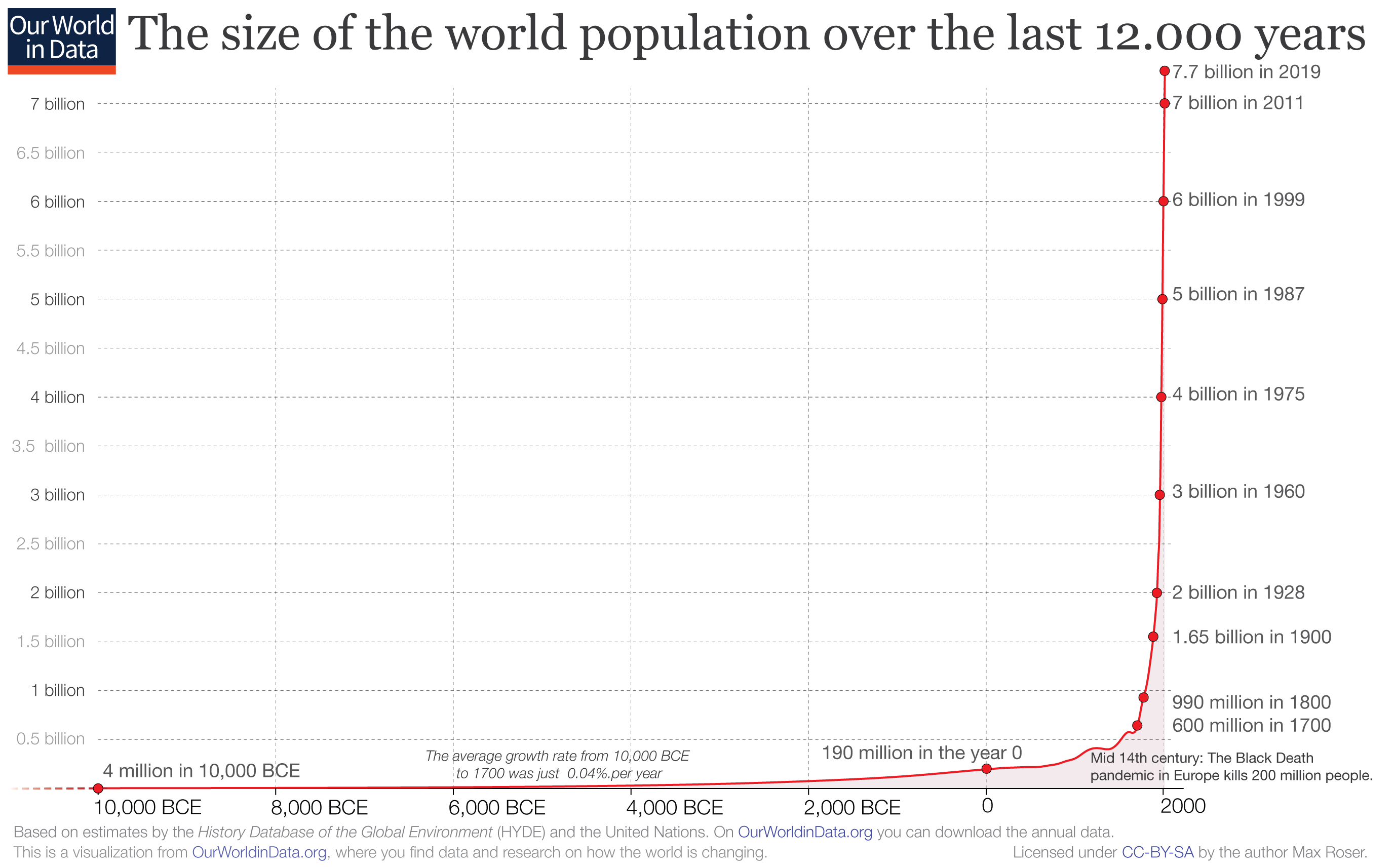
World human population, as of November 2022, now exceeds 8 billion.

I can't prove that humans have insufficient self-control and lack immunity from the laws that I described in parts 2 and 3.  However, I think I can provide some fairly compelling evidence that this is so.

Population Growth

Yes, if we use the base goal of propagation as our measuring stick, there's no question that humans have been wildly successful, as demonstrated by the graph above.  (By the way, that graph goes much further to the left, and stays just as flat.)  And yet, one would be hard-pressed to find a single human who believed that our planetary home or our prospects for a successful future are in any way improved by our explosive growth in numbers.  Moreover, we have convincingly known this for at least two generations.  In that time, we have developed cheap and effective birth control, reduced birth rates through education and empowerment, and even imposed restrictions of family sizes.  The fact that our birth rate has declined moderately in the last 50 years suggests that we can indeed control it.  However, our actual population in the same period has doubled.  The basic math tells us that the way things are going, it will be a long time before that kind of declining birth rate has any appreciable effect on our crippling problem of overpopulation.  Our biological imperative to propagate still rules.

Consumption Control

I can't argue that humans don't have the potential for resource consumption control, but our history is littered with evidence of societies not exercising it.  From the tribal groups that drove thousands of bison over cliffs in order to consume just a few, to the peoples who cut down the very last tree on Easter Island, and even to the trawlers which now empty our seas of precious fish stocks and ranchers who burn down the rainforests - we refuse to see nature's bounty as finite.

One factor working against any practical application of self-control is our modern definition of value, where scarcity drives value higher.  We therefore doubly profit by harvesting most of nature's riches within our own lifetime.  It is true that we have applied our amazing intelligence to introduce remarkable efficiency in our productivity, but efficiency has never been used to reduce consumption - it invariably increases consumption at greater profit.  Like every other living thing, humans make maximum use of available resources.  The only difference our brains make is that we can consume to deadly effect.

Irrational Species with Flawed Values

Yes, humans are incredibly smart and self-aware, but, as Bill Rees points out (as his first premise), we are not rational creatures.  He says: "passion and instinct often trump reason, particularly in times of crisis".  Worse yet, even when we are supposedly being 'rational', our Modern Techno-Industrial civilization has adopted quantity as its predominant value system.  When value is quantity, then More is Always Better.  As a consequence, our rationality is exercised within a value system which has no concept of peak sufficiency - within a natural world where absolutely everything incorporates the concept of peak sufficiency as an imperative.

We run our Modern Techno-Industrial civilizational using 'economic principles', based on mathematics, that only work in an unreal world, based on a false assumption of all humans as rational agents within a system of simple rules and calculations.  Our ability to alter the impacts of our reality has led us to believe that we can alter reality itself.  Again, to borrow from Bill Rees, "human beings 'socially construct' their own realities.  More accurately, we construct social lenses through which we perceive reality (e.g. political ideologies, religious doctrines, scientific models, economic paradigms, cultural narratives, etc.)"  As a result, "the conceptual lenses through which we perceive reality determine the kind of reality we perceive."  We are no longer able to be objective observers of what we are doing to our environment - we only see a tiny keyhole view of what we choose to look at and be aware of.  Thus, we are able to create the Myth of Self-Control and Immunity.

Failing at Improving Nature

There is no question that the belief in humanity's control over nature and immunity from its laws is widespread.  As a result, we act, and act quickly, whenever we see an opportunity to supposedly improve on nature and bend it to our will.  Our history is clogged with ever-increasing instances of where that behaviour has backfired with dramatic effect, climate change being simply the latest.  We wipe out entire species, with no understanding of the impact that removing key components from the complex network of life will have on the entire system.  We voraciously alter the landscape with our sprawling cites of pavement and concrete, and our decimation of entire ecosystems in search of more resources to consume.  We poison our world with biologically-indestructible plastics and lethal new chemicals, with only the tiniest of guesses on their long-term impacts (if we even care to consider them).  We commit, all in, to these virtually untested technologies, and make irreversible decisions based on profit over survival.  We think we can do better than nature's billions of years of trial and error and system evolution.  At best, we fool ourselves with short-term gains, only to fail spectacularly for the long-term.  Every time.

Common Heuristics for Negative Feedback

The best negative feedback against uncontrolled population growth and other problematic behaviours is not harsh environments like extreme cold or the pressures of the ocean floor.  We already know that, given time, life can adapt to those challenges and even thrive there (as humans can do.  Humans are not unique in that respect - the only difference is that instead of physically evolving for such environments, we evolved the intelligence to deal with them, allowing us to transition much faster than if we had relied on changes to our physiological design.)

No, the best negative feedback comes in two forms: Changes that happen faster than the species can adapt to them, and (in its purest form) reactions that are a direct result of the unwanted actions (and correspondingly scalable).  Generally speaking, change in nature does not happen very quickly.  The most common changes, like the seasons, are predictable and the cycles themselves rarely change, allowing species to adapt and thrive.

As mentioned, the most efficient negative feedback is undesirable outcomes driven directly by the actions of the species, such as starvation due to excessive population growth with limited food sources.  The greater the population boom, the more depleted the food sources and the more catastrophic the effect on the species.

Conclusion

From the characteristics discussed above, climate change is particularly well categorized as negative feedback.  Even though its progress seems pretty slow to us, the localized effects like forest fires, floods, mega-storms, and even sea-level rise are happening faster than humans and human infrastructure can move out of the way.  More importantly, the effects of climate change (and their severity) are directly attributable to our own actions - there is no doubt of that anymore.

No one can dispute that humans have significant self-awareness and impressive self-control - as individuals.  However, our impacts are now significant enough that they are subject to nature's most powerful complexities - systems that we cannot begin to fully comprehend.  Humans, as living organisms, are not immune to the Law of Propagation and Consumption, and while our intelligence has given as a huge advantage over some of nature's minor limiting factors, we are clearly still subject to the potentially fatal Law of Negative Feedback - even feedback of our own creation.

(Continue to part 5 of 9)


Tuesday, November 22, 2022

#2 - The Law of Negative Feedback

 (This is the third of a nine-part installment, offering a fresh new perspective on Climate Change.  For the big picture summary, see Turning Climate Change on its Head.)

Exponential growth and non-stop resource depletion are entirely unsustainable on a finite planet.  Nature controls for these imperatives by providing negative feedback mechanisms.  Evolution balances these two forces.  However, if the negative feedback is too great, the species will disappear.  On the other hand, the negative feedback can’t fail, because if it did, the unsustainability of exponential growth will be its own demise - it’s the ultimate negative feedback.


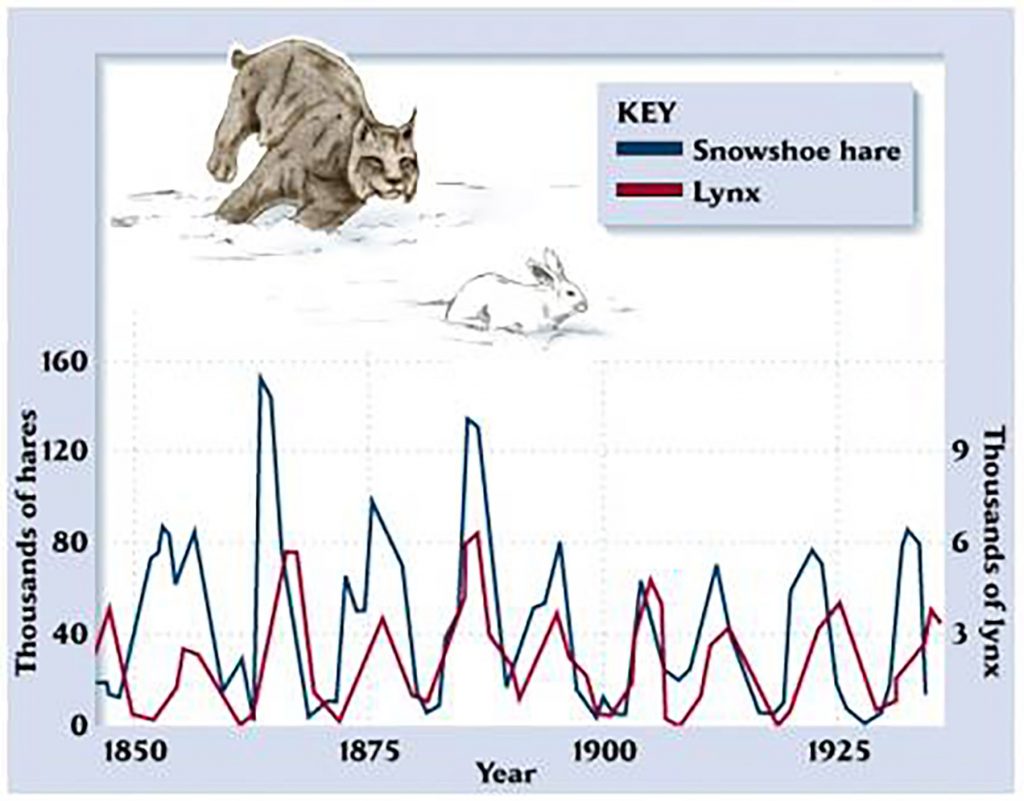
Evidence of hare and lynx population cycles

In part 2 (The Law of Propagation and Consumption), we established that, in the absence of counter-balancing forces, every living species would theoretically experience exponential growth.  The reality is that this does not happen in nature.  Populations grow and decline, often in somewhat predictable cycles.  Sometimes a population will decline to the point where a species will go extinct, but it has never been the case that a population's growth has continued unchecked to the point where it is occupying every square inch of the planet, crowding out every other living thing. 

Evolution is a remarkable, self-regulating process, operating in an environment of interconnected systems, whose complexity far exceeds our capacity to fully understand it.  One of the key attributes that evolution has created is a system of negative feedbacks that provide the counter-balancing force to population growth, referred to above.  If we can accept that no species is programmed to control its own population numbers, then this proves that something is controlling that exponential growth.  (Even if a species could be shown to be controlling its own numbers, would that not be evidence of nature giving them negative feedback that they were reacting to?)

We can demonstrate the presence of negative feedback by examining the three possible outcomes of a species population growth:

(a)  Extinction

The population declines permanently to zero.  As mentioned above, this would be evidence of negative feedback going too far, driving a species to extinction.  You may wonder why this does not happen very often.  (In the natural world, with no human interference, the extinction rate is estimated to be between 0.1 and 1 per million species per year).  The explanation is that nature's systems and cycles have been adjusting and fine-tuning themselves over millennia.  In the absence of rare, catastrophic events (e.g. a meteor impact), if the systems did not support the eventual restoration of any given species population, that species would have already disappeared a long time ago.

(b)  Steady population or cycle

Maintaining any living organisms (be they animal, plant, or microscopic) at a precise and constant population number would require a direct oversight that would be out of place in our natural world.  It is easier to accept that biology's intrinsic system designs merely react to the numbers going up or down in such a way that balance is eventually restored.

In the image shown at top, evidence of lynx and snowshoe hare populations in Canada's North over nearly a century was derived from the fur trading logbooks of the Hudson's Bay Company.  What we see is that as hare populations increased, the lynx numbers soon followed.  This is because the snowshoe hare is a common food for the lynx; a greater number of hares mean that a greater number of lynx remain healthy and survive the winter.  Following its own innate propagation programming, more lynx also means more having offspring that will also be feeding on the hares.  Eventually, the hare numbers begin to go down as they are eaten by the growing lynx population.  As soon as the hare numbers drop, so do the lynx numbers, as their food source disappears.  Of course, the lynx/hare pairing is not an isolated system.  Hare populations will also go up and down in relation to their own food sources and how many hares have to compete for that sustenance.

Limited food supply, which becomes scarcer as the consuming population rises, is one of the most common examples of nature's negative feedback mechanisms.  Another is susceptibility to disease due to increased population density.  Note how both mechanisms intrinsically become more effective as the population numbers increase - that's how negative feedback works.

(c)  Uncontrolled growth

All life, as we know it, requires energy consumption and habitat space.  If we presume it possible for any given species to increase in number without end, then the available energy and space would also have to be unlimited.  Neither is true on this finite planet.  Therefore, even if you could imagine a species that was able to circumvent every possible negative feedback mechanism thrown at it by nature (i.e unlimited food supplies, no increased susceptibility to disease, unlimited energy, etc.), that population would sooner or later hit the natural limits of energy and space on a finite planet.  In this case, you could think of those limits as being the ultimate negative feedback.

Astute readers will notice that humans seem very close to being examples of this third possible outcome.  They have adapted to life on every possible environment of the planet, managed their own food sources, cured diseases and increased life expectancies, found new energy sources, and (some might say) are even poised to colonize other planets.  I consider this an illusion, and we'll discuss this next in part 4 (The Myth of Self-Control and Immunity).

Conclusion

Looking at the three possible outcomes, I suggest that, from the collective perspective of any given species, the most desirable outcome is the second one, where nature uses negative feedback to manage the innate growth of their population to levels which can be sustained for many, many generations, evolving as time and other factors permit.  In other words, if we accept the first Law of Propagation and Consumption, then negative feedback is necessary for sustainable species existence.

(Continue to part 4 of 9)

Sunday, November 20, 2022

#1 - The Law of Propagation and Consumption

(This is the second of a nine-part installment, offering a fresh new perspective on Climate Change.  For the big picture summary, see Turning Climate Change on its Head.)

All living species are programmed at their core to propagate and make maximum use of available resources.  Evolution has consistently selected for these properties.  When these biological imperatives are unchecked, they lead inevitably to exponential growth and resource depletion.

Aerial view of Cairo, Egypt

Propagation

There is not a single living species, animal, plant, or microscopic, that has not been programmed for propagation of its species.  If it were otherwise, that species would have disappeared thousands of years ago.  I think we can confidently assign the term "Law" to this fact.

From a statistical perspective, we can also state emphatically that the average basic reproduction number, or R0 ("R-zero" - a term we got to know during the CoViD-19 pandemic) has to have been 1 or more.  That means for the average population of a given species, they are producing at least the same number of progeny - and typically, many more.  If they are not, or their progeny are not surviving until they are reproductive themselves, then that species population will be in decline and, again, will eventually disappear.

Death is a fact of life, and for reasons that we will explore more thoroughly in part 3 (The Law of Negative Feedback), we know it to be the case that not every individual in a given species population will survive long enough to produce a replacement progeny.  For that reason, it is almost always the case that the average number of offspring it has will be greater than 1.  In the animal kingdom one of the most prolific species has to be the seahorse, which has about 2000 offspring with every successful mating.  In the plant world, trees can produce tens of thousands of seeds - each with the potential to grow into a mature tree.

Let's consider what would happen if the basic reproduction number is greater than 1, and ALL progenies were to survive to reproductive maturity.  Firstly, the population will grow, obviously.  Eventually, it will double in size.  And then double again.  And again.  By immutable mathematics, this growth will be exponential.  In other words, the growth will not be a straight-line increase.  On top of the population increase, the number of additional progenies in every generation will itself increase, producing a curve that will slope ever more vertically. 

Consumption

The second part of the proposed law - that every species makes maximum use of available resources - is less necessary to my final conclusion.  Still, even though the proof may not be as empirical as for the first, every piece of anecdotal evidence available to us suggests that the second part is also true enough.

It is safe to say that all life, as we know it, needs to consume at least a bare minimum of resources in order to survive to reproductive maturity.  If the consumption of any given resource would be to the organism's advantage - especially if it would further the goal of propagation, there is no species that consistently and consciously makes its own decision to conserve resources instead of consuming them.  And if the population is growing, that survival imperative of that species will drive it to consume all available resources, as needed.

If you combine the consumption of at least a fixed minimum of resources with a population experiencing exponential growth, then the overall consumption of resources will also be growing at an exponential rate.  If these resources are not being replaced at the same rate at which they are consumed, then the species will, once again, eventually disappear.  Since the amount of energy and raw materials on a finite planet can be considered fixed, exponential growth of resources is unsustainable.

What about Humans?

Of course, it is very tempting to think of humans as an exception to the Law of Propagation and Consumption.  Certainly, as individuals, we seem to have acquired sufficient self-awareness and power to eschew propagation and control consumption - at least to a survival minimum.  However, overall, I believe this exceptionality to be a myth - one that we will address in part 4 (The Myth of Self-Control and Immunity) - but first, let's consider how nature typically manages population growth in part 3 (The Law of Negative Feedback).

(Continue to part 3 of 9)


Thursday, November 17, 2022

Turning Climate Change on its Head


Inspired by the work of Bill Rees (video), David Korten, and other thought leaders, I am moved to present a clear chain of thought, in six steps, leading inescapably (for me) to a surprising conclusion about Climate Change.  If widely accepted, this would turn the Climate Change Movement on its head.  I don't kid myself that this blog will have the viral impact needed to inspire real change, however, I challenge you, the reader, to choose any of the steps below and show me where my conclusion is problematic.

I present all six in summary here and have prepared a separate blog entry for each one, going into details and more explicitly presenting my case for the validity of my surprising conclusion.

#1 - The Law of Propagation and Consumption

All living species are programmed at their core to propagate and make maximum use of available resources.  Evolution has consistently selected for these properties.  When these biological imperatives are unchecked, they lead inevitably to exponential growth and resource depletion.  (Read more)

#2 - The Law of Negative Feedback

Paradoxically, exponential growth and non-stop resource depletion are entirely unsustainable on a finite planet.  Nature controls for these imperatives by providing negative feedback mechanisms.  Evolution balances these two forces.  However, if the negative feedback is too great, the species will disappear.  On the other hand, the negative feedback can’t fail, because if it did, the unsustainability of exponential growth will be its own demise - it’s the ultimate negative feedback. (Read more)

#3 - The Myth of Self-Control and Immunity

Humans are unlike any other species in the knowable history of our planet.  Our self-consciousness and incredible mastery of knowledge and collaboration collectively power a myth that the first two laws don't apply to us - that we can control our propagation and resource consumption, and that we are immune from nature’s feedback mechanisms.  This turns out to be false under our current paradigm.  (Read more)

#4 - The Complex Crises of Current Reality

Human ingenuity and technology, combined with our unnatural quantitative value system (where More is Always Better), have ultimately led to multiple complex crises that directly threaten civilization as we know it.  They include climate change, the Sixth mass extinction, resource scarcity, global poisoning, food insecurity, pandemic diseases, uncontrolled technologies, nuclear arms, overpopulation, and untenable social inequity.  These have been collectively described as ecological overshoot.  While there is no question that these crises are connected, solving any one of them will not solve the others.  (Read more)

#5a - Impossibility of Effective Climate Change Action?

Either effective action to halt or mitigate climate change is possible, or it’s not.  Let’s consider both options, starting with the second.

Climate Change is already well underway.  There’s a belief that what’s needed is serious political or corporate will, but I suggest the reality is that our predominant societal value system simply cannot accommodate the required actions.  If we also accept the inevitability of the law of consumption, and the fact that immunity from consequences is a myth, climate change WILL be in our future.  (Read more)

#5b - Consequences of Effective Climate Change Action?

It’s even more interesting when we explore what happens if halting or mitigating climate change IS possible - and we do it.  Yes, the effort would be huge beyond belief, but imagine we could actually do it.  So what about the other complex crises currently looming over us?  Even if effective action on Climate Change were possible, we are still subject to all the other crises.  Indeed, while solving Climate Change would probably help with some of them (e.g. the Sixth mass extinction and food insecurity), it would merely allow every other complex crisis - the ones without the present stature and focus of Climate Change - to worsen.  We'd be putting society back on track to its own destruction!  (Read more)

#6 - The Conclusion for an Altered Perception of Climate Change

Putting all of the preceding Laws, Myth, Reality, and Possibilities together, I propose the following conclusion:

Climate Change is negative feedback that nature is imposing on our exponential growth and out-of-control consumption.  As awful as it will be, that negative feedback shuts down our suicidal behaviours and gives us precisely the opportunity we need right now to survive into the distant future.  Climate Change is therefore a critical part of the solution for the continuance of the human species - a force strong enough to cause us to question our value systems and change course with whatever is left of civilization.

(Read more

Of course, the obvious cap to all of this is a ninth post, being A Discussion of Our Best Strategy Right Now.


Wednesday, March 16, 2022

The Environmentalist's Case Against Basic Income

At a recent talk that I was giving about my second book, Our Second Chance, I was sharing my supportive views on the concept of Basic Incomes.  Afterwards, I was reviewing the valuable comments in the Chat room, and found this gem:

"Futurist Douglas Rushkoff had espoused UBI (Universal Basic Income) in two of his books, but has since retracted his endorsement of the idea as he had come to realize that UBI without a deeper paradigm shift will only amount to increasing the rate of extraction, exploitation and consumption of earth's resources.  This is Douglas Rushkoff describing his rationale for no longer supporting the concept of UBI here."

The first 10:30 of the linked podcast is a monologue in which Rushkoff outlines his serious reservations with a Basic Income scheme - namely that it merely amplifies the population's role as consumers. Giving money to the people at the bottom will not create economic justice, he says, since that money will simply pay for increased consumption, thereby (a) continuing to line the pockets of the upper echelon capitalists, and (b) making our resource extraction and environmental degradation even worse.

Knowing that Rushkoff, a well-respected author, was changing his tune on Basic Income, led me to give his new position very careful consideration.  It is indeed a worrying proposition.  We all know that any attempt to raise the overall standard of living for a large number of people will entail a greater consumption of planetary resources - at least in the short-term.  Does that mean we are doomed to choose between widespread social inequity versus resource destruction?

Changing the Rules

Let me first say that I am very much in agreement with his fundamental objective.  In the podcast, he phrased the big picture in this way:

"It's not too late for us to start companies, cooperatives, commons where we all, everyone, owns a stake in the thing.  And then we can change our role in the economy from mere consumers to stakeholders; our role in society from consumers to citizens; and our role with each other from competitors to partners.  Now, the only substantive change we can make to our economic operating system is to distribute ownership, control, and governance of the real world to the people who live in it."

Well said!  I also agree that reinforcing the consumer tendencies of those close to or below the poverty line in our society actually channels that money to those at the top - seemingly defeating the purpose.

However, my Zoom audience member qualified Rushkoff's position more than the podcast does:  A UBI without a deeper paradigm shift, is problematic.  Well of course it is!  But a Basic Income is the best first step to achieving that paradigm shift!

I propose that, as living creatures, we are all consumers, citizens, and stakeholders (investors).  Those are the three value personae that I work from in my books (with a nod to Robert Reich).  We cannot eliminate the Consumer persona - all living creatures must consume.  A Guaranteed Basic Income (GBI) model simply says that consumption needed for survival should be free - a basic human right, based on the abundance that we now enjoy.

I confess that I don't know all of Rushkoff's reasons for turning his back on Basic Incomes, but here are my reactions to what he said in his ten-and-a-half-minute monologue:

1.  A Grand Destination with no Road Map

The proposal that he makes for a new world, with distributed ownership, control, and governance is a wonderful ideal, but that change cannot be wished or even legislated into being.  There must first be a fundamental shift in our value systems and economic models.  The real change must (most likely) come from the bottom up - from the vast swath of consumers - and to do that, you have to first release them from slavery.

(I use the term "slavery" advisedly.  Our current economic model says that, for the overwhelming majority of people, we need income and a job in order to meet our basic survival needs.  Take our job away and we are homeless, hungry, and - if the social safety nets are overwhelmed - dead.  The choice of "to work or to die" is essentially slavery.)

Basic Income is the most fundamental shift in our economic model that currently has a chance of actually being enacted,  The U.S. was two Senate votes shy of a basic income model 50 years ago.  It currently has broad support across the entire political spectrum.  The CoViD-19 pandemic did wonders for showing the general public how the basic principle might work.  A Basic Income is the best first step on the road map to the changes Rushkoff seeks.

2.  The Asset Alternative

I like the idea he mentions of giving people assets instead of income.  Unfortunately, it's not very clear what he means by "assets".  It seems impractical (and demeaning) to give people food instead of the money to buy food.  If you give them other assets, and don't change the paradigm of "money equals survival", those assets will soon be sold and you will be worse off than before.  Again, I agree with the principle of a lot more common wealth.  I don't think land or natural resources should be ownable.  But just giving away assets (if one could even do that), without rethinking the nature of ownership, does not solve the problem.

3.  Beyond the Poverty Line

Contrary to what Rushkoff says in his monologue (and contrary to common belief), UBI is not just a way to take poverty off the table.  A Basic Income alters the way everyone thinks about the future.  It impacts the non-wage-earner in an abusive relationship, the worker replaced by automation, the entrepreneur, the career-changer, the lifetime volunteer, and the new Art graduate (the one that he says usually has to go straight into a job because they can't afford a studio).  People can take risks, get better jobs, and invest in their future because their basic survival is not on the line.  Basic Income is a psychological gamechanger.  And that's what his operating system change calls for - a psychological gamechanger.  It can't happen with anything less.

4.  Follow the Money

I think he oversimplifies the flow of money when he says that the poor consumers will simply give their Basic Income cheque over to the capitalists.  I see the Basic Income scenario as including four major differences from the status quo:

(A)  We already hand out billions in social assistance.  A GBI merely gives that money out without all of the cumbersome application, eligibility, and ongoing oversight costs.  A lot of the money that would be going to those at the bottom of the pyramid is already being doled out.

(B)  In order for governments to afford these programs, they have to stop giving out the other billions of dollars in subsidies and incentives at the top.  They also have to revise tax laws and enforcement to reduce the wealth being stashed away at the highest echelons.  There are counterbalancing factors.  So even if the money eventually goes back to the 1%, it is doing people good on the way, instead of going straight into a corporate profit account.

(C)  The big picture when you level the playing field for the lower and middle classes is that entrepreneurship is increased.  Populations can afford to support local business, and finally have the option of choosing quality over the cheapest survival option.  Many shop at Walmart because that's all they can afford and they measure value by number.  A GBI has the potential to alter how we view money - as a tool rather than a survival imperative.  That paradigm shift will necessarily impact the monolithic corporations more than anything else.

(D)  Rushkoff portrays Basic Income as a very simple circle of money going from the government to the poor and then straight to the corporations.  This suggests that the status quo is preferable because when people can't afford to eat or put a roof over their heads... well, at least the billionaires aren't taking that money.  That is a pretty sad justification.  And if it's true, then where does that same money go now?  Do the governments keep it?  No, it participates in a different cycle, which is...

5. The Economic Growth Conundrum

The richest people in society profit from economic growth.  Economic growth is needed largely to create jobs and income so that we can have economic growth.  It is a vicious circle where those at the top reap the greatest benefit.  We have been told that jobs are good because everyone needs one in order to perpetuate and expand consumption.

We also know that when more money moves around (as would be the case with a GBI), you get serious economic growth - and thus, more of what is damaging the planet.  And yet, I believe that such a cycle is fundamentally different.  When millions of people don't need a job just to survive, they can choose more meaningful occupations.  We don't need to create bullshit jobs just to keep people busy and paid so that they can eat.  A GBI allows people to reconsider what is important to them, and returns consumption to a simple survival imperative instead of an economic one.  It makes it possible for an environmentally sustainable cycle to emerge.


In summary, I think Douglas Rushkoff is correct that a Basic Income, on its own, is not going to solve our flawed economic model.  Yet, I don't think that solution should ever stop there.  A GBI is merely the first game-changing step in a massive paradigm shift about how we value people and what is important to us as a species and as a society.  Yes, the digital behemoths have to be broken up and we have to re-write the myth of commercial corporations.  Yes, we need to reduce our role as consumer, and increase our stakeholder and citizen values.  And yes, we need to revisit asset ownership, control, and governance.

I am convinced that the best and most likely path to making all of that a reality is to change how we think about money and survival, and the most practical, realistic, and currently relevant way of doing that is with a Basic Income.