Thursday, April 2, 2020

Free Survival

The Concise Case for a Guaranteed Basic Income in Canada

Installing a floor in a house with no ceiling.

Imagine you lived in a country where every permanent resident was guaranteed a basic income that provided for the barest essentials of life.  Don’t question where the money will come from – we’ll get to that in a moment.  Simply imagine that the poorest people in the land each received, say, $1000 every month, no questions asked.  How would that country be changed?

Now imagine a contrasting scenario, where you live in a country that has no universal single-payer health insurance.  (Canadians can easily observe such an example below our southern border.)  What would happen if you slipped and badly broke a bone, or got a viral infection during a global pandemic, or had a child who needed urgent care, and you could not afford to pay for a doctor or a hospital visit or an essential operation?  Would any Canadian ever want to go back to the days before 1962 when that was actually the case?

If you are still having trouble with imagining the first scenario, but are all in favour of universal healthcare, ask yourself why medical treatment should be free but essential survival should not be.  Canadians don’t apply to be accepted to a hospital when they are sick – they are simply taken in and treated.  So why should a homeless person get free food and shelter from their government when they are in a hospital, but not outside of one?  How did creating wealth for someone else (i.e. a job) become a prerequisite for life?

The Status Quo

Like most wealthy countries, Canada generally offers social assistance – welfare – to those who apply for it and meet the eligibility criteria.  We don’t like to see people starving on our streets.  In poorer countries, such people might turn exclusively to begging in order to survive.  As a society, we don’t tend to hold welfare recipients or beggars in very high regard.  For those of us not fortunate enough to inherit our wealth, we have to work to earn a living, and it’s a bit irksome to see welfare money (our tax dollars) going to those who seemingly don’t.

While being on welfare and begging can certainly have a similar feel and stigma, the differences between the two are not all one-sided.  Social assistance is perhaps more predictable and has a less visible indignity, but at least if one works harder at begging, one can potentially earn more money.  Most welfare programs, on the other hand, are set up such that if you attempt to better your lot by getting work, every dollar that you earn is subtracted from your assistance cheque.  That’s a tax rate of 100% on our lowest income earners.  Indeed, there are some scenarios in which one or more part-time minimum-wage jobs might actually take the overall household income below the welfare payment level, discouraging recipients from even trying.

A guaranteed basic income (GBI) is different.  It is a commitment from the Government of Canada that no-one will be denied the chance to live.  It would be available to every adult citizen and permanent resident, linked to their social insurance number (SIN), and paid every month.  Every Canadian would receive the same amount, regardless of what province they live in or how much they have earned in the past.  If a recipient earns more than a defined threshold in any given year, the excess could be taken back at tax time.  Anyone can opt in or out at any time.

The remainder of this work will be devoted to answering the following questions:

Has this ever been tried anywhere?

Absolutely.  Minimum income schemes are not just pipe dreams.  In the last 50 years there have been more than 30 such programs introduced on an experimental basis around the world – with very promising results.  In Canada, a pilot project in Dauphin, Manitoba was conducted in the mid-70s, and in three communities in Ontario (2017-19).  Around the same time, another guaranteed basic income program was tried in Finland.  Furthermore, at the time of writing, there is an all-party committee putting together the plan for a province-wide pilot program in Prince Edward Island, and a separate commission of inquiry looking at basic income programs for British Columbia.  We’ll examine some of their results in the responses to more questions below, but generally speaking, the outcomes have been overwhelmingly positive, and fiscally responsible.

What are the benefits of a GBI?

The straightforward benefits in terms of poverty reduction should be obvious.  If someone has a guaranteed basic income every month, regardless of other circumstances, at least they have a fighting chance.  Poverty is not caused by a moral failing, or a shortage of will, or a lack of character.  Poverty is not a mindset, or a choice, or laziness.  Poverty is caused by having insufficient funds.  Period.

Money doesn’t solve everything.  But the benefits of having a guaranteed basic income go far beyond the bank account and dinner table.  Where GBI pilot projects have been run, the improvements to social well-being were irrefutable.  Generally speaking, the physical and mental health outcomes of participants improved, education and graduation rates went up, and negative encounters with the law went down.

New mothers have more options; youth have more options; the homeless have more options; former inmates trying to rebuild their lives from scratch have more options; people stuck in dead-end jobs have more options.  Artists and entrepreneurs can survive while pursuing their dreams and making our world a better place.  While one person’s GBI might not pay the full rent in some cities, recipients can band together and pool their resources.

Those in need can get immediate assistance, with their dignity intact – no applications, no assessments, no ongoing administration.  When there is no longer a need for soup kitchens and food banks, charitable giving can then be redirected to other worthy causes.

The simplicity and summary benefits of a GBI have yet another significant benefit.  Most of us (certainly in prosperous nations with insurance safety nets) now live without the daily fear of being attacked by a predatory animal, or succumbing to a minor natural catastrophe, or being killed by a rival tribe group, or losing everything in a fire, or suffering a medical trauma.  What fear could nearly universally apply to anyone in today’s society (pandemics aside)?  Unemployment.  Losing it all.  Not having the money to live in the manner to which one has become accustomed.  Not having the savings to retire from a life of labour.  It’s a serious fear.  (Yes, there was the CoViD-19 pandemic.  And what did the Canadian government do?  Did its bail-out package save the people?  No.  It attempted to save pre-existing workers and the economy.  The concern was not feeding the population – it was saving the jobs!  Those who were already vulnerable got nothing.)  Knowing that there is a guaranteed secondary safety net, even if savings and friends are no longer able to help, means a huge stress point is alleviated for every single Canadian.

Speaking of pandemics, imagine what would have happened if a GBI program had already been in place when that global crisis occurred.  The back-up system would have been well-defined and ready to go.  The universal income amount could have been tweaked as necessary, and all non-essential workers could have immediately gone home to wait it out.

Wouldn’t people stop working?

A GBI is no free ride.  On the contrary, it provides the bare minimum needed for survival.  It just moves the starting line up for people trying to lift themselves out of abject poverty.  It’s also the backup safety system that many need for taking new risks and exploring new opportunities; getting the education that truly appeals to them; weathering a sudden personal disaster; taking the time to find a vocation that is a great fit for their talents and interests.  Humans do not want to be idle all their life.  They want to be productive and to contribute in meaningful ways.  If they are given the keys to the many doors of opportunity standing before them, they at least have a chance to start opening them and to better themselves.

A basic minimum income would not pay for a standard of living that anyone would choose for themselves.  If you want a nice place to live, internet access, a car, a cell phone, nice clothes, and all the other great things that many of us enjoy in Canada, you are absolutely going to need a job.  For example, if the GBI were $1000/month, nobody is going to choose to live on $12,000 per year.  (But it might just save your life if that’s all you had.)

This conclusion is borne out by the GBI pilot projects which consistently demonstrate that there was no inclination for participants to work less.  Notable exceptions were new parents who chose to spend longer periods out of the workforce to be with their babies, and youth who chose to further their education instead of taking the first job that they could find.  The collective benefits of both of those types of decisions are clear.

Moreover, as mentioned earlier, some of the present traditional social assistance programs do actually discourage people from working – especially those with dollar-for-dollar claw-backs.  A properly-designed GBI does not work that way, and would not have the same effect.  However, it does open up alternatives so that the most disadvantaged are not slaves to demeaning sweat labour just to survive another day.

What are the social costs of a GBI?

One very sad criticism of GBIs is that the money will simply be wasted by the recipients.  This is of course nonsense.  The people living at the bottom of our social pyramid are the ones most likely to know what they need to survive.  Indeed, they are probably in a better position to make those decisions than some government bureaucrat designing a social assistance program in a committee room somewhere.  The flexibility of a GBI gives people the dignity and options to make the choices that are right for their individual circumstances.

The other thing you will hear is that a GBI will simply be used to enable addictions such as alcohol, drugs, and gambling.  This kind of distorted thinking is ridiculously biased and narrow.  Addictive behaviours can be found at every income level of society.  These problems are by no means limited to the poor or marginalized people, nor would they be attributes of the vast majority of those that need financial assistance.  Our mental health system should be focussed on treating these addictions, wherever they show up in our communities, not on treating the despair and anguish of poverty.

Furthermore, studies show that even those with addictions do not view such income as something to spend on their unhealthy habits.  On the contrary, knowing that such an ongoing benefit could (and likely will) turn their life around, they take the opportunity to improve their well-being and live better lives.  Many addictive behaviours are born of despair for any hope for the future.  A GBI can supply that missing hope.

Another argument is that a GBI will make people dependent on the government for their survival.  This is far more likely an outcome of the existing welfare systems that pays supplements well below the poverty line, thereby keeping people in poverty.  Even for those rare cases where, for whatever reason, an individual is not able to capitalize on all of the benefits listed earlier and is forced to continue to rely on their GBI payments in order to live – is there really anything wrong with that?  Plenty of average citizens have exactly the same dependence on our universal healthcare system.  If you can’t fall back on the basic humanity of your country, what hope is there?

Where will the money come from?

While this might be the most obvious question to pose, I saved it until now because some of the responses to the earlier questions set the stage for this one.  The answer must also be prefaced with the fact that while we can fairly easily calculate the costs of a GBI program, there are likely to be even more indirect financial benefits than have already been confirmed by pilot programs.  This is because a GBI inspires profound longer-term changes to society itself as well as individual well-being.

To begin with, there is the money from existing programs that would no longer be needed.  A GBI can replace social assistance, income supplements, tax incentives, subsidies, and more.  These kinds of savings include not just their outputs but also the costs associated with managing their applications, assessments, and ongoing administration.  Under at least one proposed GBI implementation, these federal and provincial savings alone would cover 60% of the direct costs.

Then there are the secondary savings that have always gone hand-in-hand with real poverty reduction:  reduced healthcare costs, lower crime rates, reductions in serious family conflict, etc., all of which otherwise represent a significant burden on the government coffers.

Even after all of that, will a GBI be a net-zero cost program?  Probably not.  However, any net cost would arguably be an effective investment in universally raising the quality of life for every Canadian, whether getting the GBI or not, because of an overall improvement in the well-being of our communities.

Where else might the money come from?

Unsurprisingly, critics of GBI and similar programs immediately translate such proposals into a massive tax increase.  Why, they ask, should we be working hard and paying taxes so that it can be given away to the people at the bottom layer of society?  Since the implementation of a GBI might very well entail some changes to the distribution of the tax burden, those are valid questions to consider.

And yet, would it not make even more sense to ask why that same majority should be working hard and paying taxes, while some of the highest income earners in the land leverage complex tax loopholes, finagle trusts, hide income off-shore, and generally use their existing wealth to generate new wealth for themselves at a rate that most could not begin to imagine?  While it is extremely important for society to address poverty, it is equally important to address income inequity as those gaps widen ever further.  So yes, I think it safe to assume that the introduction of a universal GBI for Canadians is also going to involve some of the country’s wealthiest individuals and corporations paying taxes that more closely reflect their actual earnings.

That being said, it is also true that putting more money into the hands of more people also clearly leads to more economic growth.  If the poorest people in Canada can suddenly afford more food and other essentials, that buying power translates directly into a healthier economy.  That means more revenue overall to help pay for the GBI that made it all happen.  As prosperity grows, the demands on the GBI actually decrease.  (By contrast, under the status quo, poverty is self-replicating – it reinforces its own permanence.)

Isn’t a GBI total socialism?

Technically, no it isn’t and I’ll say why.  But before I do, dismissing an initiative that has the proven benefits outlined above, just because of its apparent political genre is the kind of closed-minded thinking that can hold back an entire nation.  Unfortunately, it is also the most common form of knee-jerk criticism when a GBI is debated in the general population.

Socialism, in the literal sense, is where the means of production, distribution, and exchange is owned and/or regulated by the community – none of which are really attributes of a GBI.  However, in common usage, the term “socialism” is often applied whenever the government is seen to be giving something away.  Universal healthcare, which the vast majority of Canadians support wholeheartedly, is closer to socialism, since the government does indeed define what healthcare is offered and control how it is delivered.

The existing social assistance programs are also closer to socialism than a GBI, since they are much more tightly regulated by the governments administering them.  It might surprise those on the right of the political spectrum to know that there is significant support among conservatives for GBI initiatives.  Even Milton Friedman, that great champion of neoclassic economics and libertarianism, was a supporter of minimum basic income programs (which he called a “negative income tax”).  Such programs appealed to him because it put the money and spending decisions in the hands of the people, not a central planning authority (and as such, were the opposite of socialism).  It is also worth noting that the recent three-year GBI pilot program introduced in Ontario in 2017 had the explicit support of all three major parties, and was in fact designed by a long-standing staunch Conservative, former senator Hugh Segal.

Why does anyone deserve a GBI?

There are several ethical arguments for a national GBI.  Here are a few:

Firstly, for the same reason that you deserve free healthcare.  In a country of so much abundance, the essentials of life should be provided to those with no other option.  A GBI offers survival with dignity, so that every person has a chance to become a contributing member of society.  The status quo does nothing to eradicate poverty – it simply keeps people there.  That is not the objective of society or humanity.  You might be lucky enough to not have to sleep on the street, but how does it feel to you when you see others forced to do that?  Everyone benefits when the lowest point of society is lifted.

Secondly, ask yourself:  What is the source of any other money in our present economy?  A large percentage of it comes from the real wealth of the nation – its natural resources, its sustainable energy sources, its collective technological know-how, and its broadly held culture and stories.  These are things that arguably every resident has equal claim to, so why shouldn’t everyone receive a dividend from this wealth?  Putting it another way, ask yourself why those few super-wealthy people who presently take significant wealth from such common national resources deserve to do so.

Thirdly, we must never forget that a GBI applies to everyone, regardless of upbringing, social status, or former income level.  It does not just rewrite the future prospects of our most vulnerable and disadvantaged populations; it also completely changes the way each and every one of us think about our own job security and our freedom to make choices that are right for us.  A GBI is there for everyone, and anyone can activate that safety net, if and when they need it.  This includes middle-income people with no savings fleeing domestic violence.  It includes victims of natural disasters or fraud who have lost everything.  It includes the disillusioned elite who need some time to redefine their life’s purpose.  It includes visionaries who choose voluntary simplicity and a life of volunteerism to help their fellow human beings.  A GBI changes the entire paradigm.

Where could this lead?

Already, a guaranteed basic income is a better solution for ‘current’ times.  It can be designed to provide a fiscally and socially responsible way to provide more effective help for those in need under the economic paradigm that we have lived under for decades.  But it can also be a total game changer, ushering in a whole new economic paradigm.

As we live today, survival is largely predicated on wages.  We exist in the relentless pursuit of money, a number-based value that has no concept of sufficiency.  More is always worth more.  The universal objective became the maximization of wealth, when the horrible truth is that wealth cannot be maximized – we can always earn more.  There is no maximum!  We devote our incredible life potential in pursuit of the impossible.  Furthermore, no matter what wondrous creativity we possess, it is held to have no value if it cannot be monetized.  “Not good enough – you need a real job.”  Where does this value distortion come from?

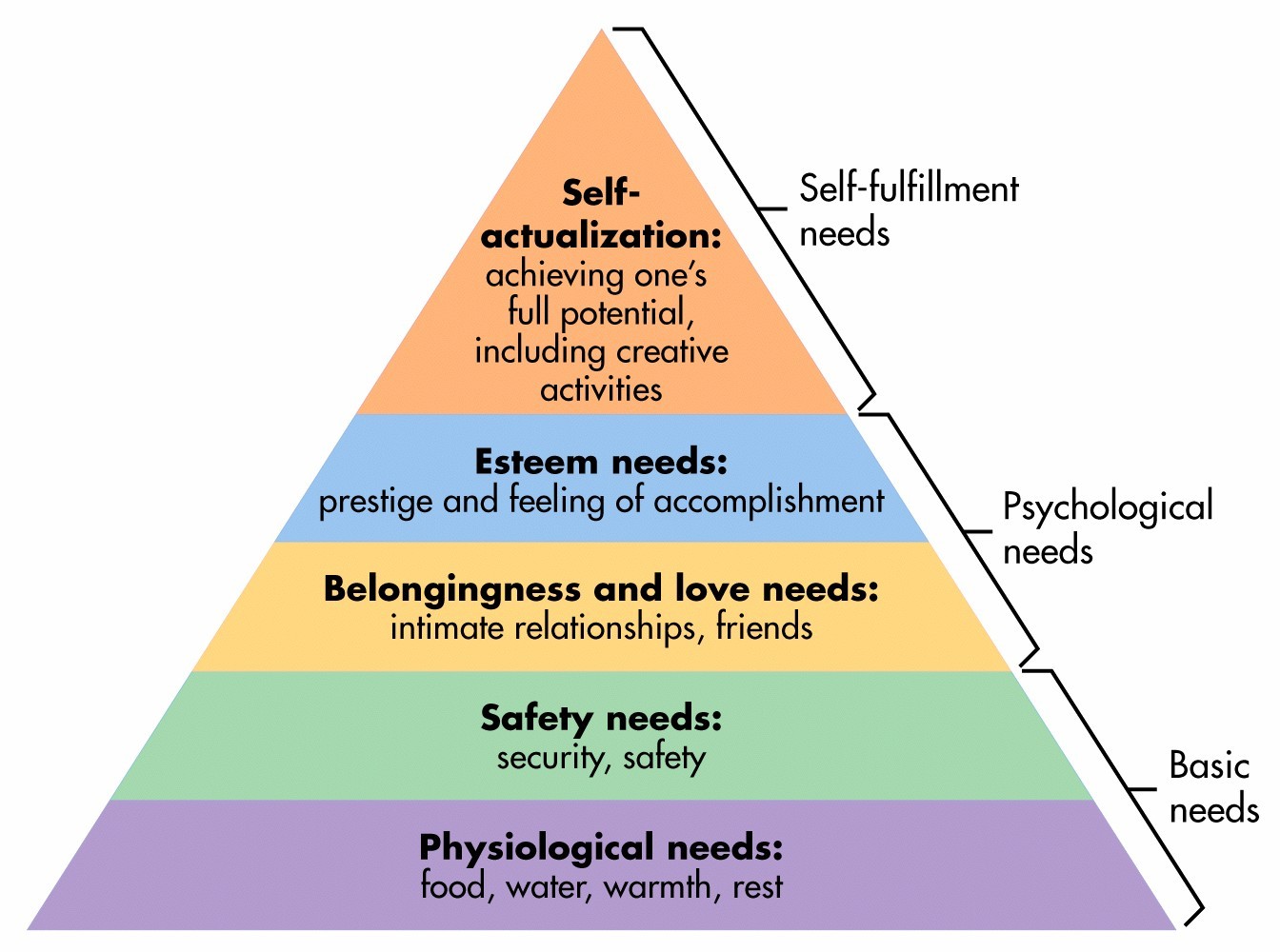
It comes from civilization’s present manifestation of the bottom layer of Maslow’s famous Hierarchy of Needs.  Physiological needs are the most basic of human requirements, and our modern framework says that to meet those we need money.  For many tens of thousands of years, this was never the case.  For our ancestors, just like for every other species on the planet, the essentials of life were supplied by the natural world.

When money became essential for life, its value was inextricable from survival.  We were taught from the earliest age that we were put on Earth to work non-stop so that we could eat.  Our education was entirely geared to preparing our money-earning potential because this is how we were going to spend the rest of waking lives: working.  At first, most of the work was productive to society and perhaps aligned with our collaborative instincts.  However, over time, work has become more of a life of earning money for those at the top of the pyramid – or worse, for faceless corporations that now rule over our societies.  The consumption of planetary resources is no longer for our survival – it takes place to create an economy with two different objectives: (1) to enrich those who already have far more than anyone could ever need, and (2) to create enough jobs so that the workers can all continue to work and afford to consume what is being created so that the cycle may continue.

We all fully understand that success takes work.  Happiness and productive lives require some effort.  But what if survival was free?  What if the ability to afford the essentials of life was something you never had to worry about?  Imagine the phenomenal freedom that such a societal evolution would release us into!  Why couldn’t our public revenue (especially corporate taxes) be used in that way?  Why shouldn’t they be?  Such a base line would buy all of us the precious time that we need to rethink our economies and our actions on this planet.  We could change the course of society without the constant paralysis caused by the law of job preservation trumping every other major change initiative.

It is very hard to predict what such a world would look like, but it is easy to see that it would be better than the obsessive and unsustainable pursuit of growth that we are stuck in now.  Perhaps guaranteed basic incomes would extend to become universal basic incomes, available to everyone, rich or poor.  Perhaps money would be entirely uncoupled from survival somehow.  Perhaps food and shelter would simply be given, and our economies would focus on science or the arts or healing our planet.  Who knows?


More reading:
Basic Income Canada Network
Basic Income Earth Network

Wednesday, March 2, 2016

Doing The Right Thing - Part 1

As conversations about The Value Crisis proliferate and mature, there is still a desire to find ways of applying the book's principles in some useful manner.  In this post, I present two common and easily recognized ethical dilemmas.  Then I share a argument for how not to resolve them, along with some hints as to how you could, by recognizing the difference between number-based and human values.

Both topics arose in everyday conversations in the last month.


Conversation #1:  A colleague was telling me about his friend who is a fanatical watcher of Freecycle lists.  These are community initiatives where people who no longer want a household item can post it on a list so that anyone who needs that item can come by and pick it up for free.  Part of the intent is obviously to keep potentially useful things out of the landfill.  However, this friend has turned the service into a business for himself, racing to the donor before anyone else, picking up the free items, and then turning around and selling them.  Is this ethical?  The owner was giving the stuff away for free anyway, and anyone else could do the same, so what's the harm?

Conversation #2:  Canada is in the midst of bringing in 25,000 Syrian refugees to become fully-fledged Canadians.  At the same time, the Canadian government wants to cut back on their military presence in Syria, potentially reducing their role in taking out the regimes that are responsible for there being refugees in the first place.  The cost of transporting, housing, and feeding all these refugees is enormous.  Is it really ethical to fast-track this particular class of immigrant and spend so much on them when there are already plenty of citizens in just as a great a need for housing and food?

A common way to think about such dilemmas is to consider who benefits and who is harmed by such actions.  The basic principle is that an ethical choice would be the action that provides the greatest good for the greatest number.  This philosophy, known as utilitarianism, seems quite reasonable, and most would accept the concept in theory.  One attraction is that it has the potential to provide a clear-cut, rational decision based on a rational and objective calculation.

Let's consider the dilemmas I presented in light of utilitarianism.  In the first example, the person giving away the object has presumably decided that they can't be bothered to sell it - their benefit is simply getting rid of it, while knowing that it's going to a good home, not the landfill.  It is likely that more than one person may desire the free object, but only one person can own the item.  If the recipient gets it for free, then a second person derives benefit.  However, if my colleague's friend gets there first and goes to the bother of selling the object, then he gets some cash (second benefit) and a third person gets a good deal on a used object.  In terms of assessing harm, no-one loses anything that they already had, so it's win-win-win, right?

In the second example, it is true that taking thousands of people from their homeland and livelihoods, flying them to a foreign country, providing them with all of the basic necessities at no cost to them (but significant cost to the host citizens), teaching them a new language, and then trying to find them affordable housing and employment - all makes no economic sense.  Nor is it fair to many of the host country's own people who are already struggling with the same challenges, or to immigrants from other countries who have to wait years to be accepted.  Many people are harmed compared to benefit for a relative few.

My difficulty with utilitarianism is that it is essentially a number-based value system.  It attempts to maximize a supposedly quantifiable measure of happiness (or more accurately, "utility").  Even assuming that most people can find a common consensus of what constitutes good, and that they can predict outcomes with sufficient accuracy, there are problems with the philosophy.  Critics of utilitarianism say that under such a value set, it is easy to start arguing that the ends justify the means.  In other words, we stop considering the ethics of the means because a utility-maximizing value system is teleological - meaning its morality is determined by the end result.  When put in this light, it is quite easy to come up with examples of where the ends do not justify the means.  Many thousands of consumers might derive significant benefit from the work of a relatively small number of children enslaved in a foreign factory making cheap goods, but that's not the kind of calculation we should be performing to determine ethical practices.

A common alternative to a results-based ethical system is a rule-based one, such as can be found in most religions.  We measure our actions (the "means") against a predetermined set of rules.  Of course, such systems have there own distinct pitfalls.  Rules are inflexible, they don't respond well to exceptions, and they can easily do more harm than good.  Democracy - a numbers-based value system studied extensively in Chapter 9 of The Value Crisis - defends ethics by its means:  A decision is justified if the majority vote that way.  Note the inevitability of the minorities suffering under both utilitarianism and democracy.

Still, in the end, most people rely on some combination of the above to guide their actions (or to justify choices that might be questionable!).  At other times, we struggle to know what is the right thing to do.  So here are some observations, based on our original ethical dilemmas.

When I was told about the Freecycle 'entrepreneur' who grabs free stuff and sells it, I was immediately repulsed by this.  Clearly it was contrary to my own value system, so I wondered what it was that I had instinctively found abhorrent.  It is by no means obvious.  For example, had the reseller paid the original owner even a tiny sum instead of taking it for nothing, I wouldn't have the same reaction - and that's the critical clue.  It is not the profit that irked me.  Rather, I believe it to be the transformation of the gesture from one value system to another that rubbed me the wrong way.

When someone takes an item of potential monetary value and gives it away, they are expressing a different kind of value.  It's not quantifiable.  As noted above, they are freeing themselves of an item they no longer need; they can relax knowing they're not adding to the community's trash pile; and they can rejoice in the fact that it is going to someone who needs it at no cost to the recipient.  That conveys considerable benefit in human values: simplification, environmental responsibility, and generosity.  By participating in the established Freecycle system, they put the item out there with an understanding and trust that it will go to a fellow citizen for free.

'Entrepreneurs' who crassly take advantage of this system, abuse the understanding and trust, and profit monetarily from the expression of those human values are twisting and diminishing them.  It doesn't matter whether the donor is aware of this or not (and almost certainly they are not aware that this is happening).  In my books, it is simply wrong.  Integrity means doing the right thing, even when no-one is looking.

So how would anyone know that this is the wrong thing, if the feeling in their gut is either absent or ignored?  The key, and the point of this post, is to note the value system transformation.  The initial act was an expression of human values.  Turning it into a number-based transaction disrespectfully negates those human values, and once you've done that, you can't go back. The 'creation' of monetary value from nothing was not, in fact, from nothing at all - it came at a cost to human values.  (Chapter 8 of The Value Crisis talks more about what happens when we attempt to use value systems interchangeably - with some dramatic examples of the harm that can be done.)

Monetary values, in my opinion, do not have the right to trump unquantifiable values.  That kind of thinking leads to huge global challenges, of the sort we are only now beginning to acknowledge.  And fixing those huge issues starts with each and every one of us being able to recognize the right thing to do.

Perhaps that's enough to chew on for now.  I'll talk about the refugee conundrum in "Doing The Right Thing - Part 2".


Wednesday, February 24, 2016

Is José Bautista greedy?

Of all the questions raised at our most recent Value Crisis Exploration, this one seemed to sum up a good portion of the evening.  I'm sure there is a detailed background that we could go into on this sports story, but I'll stick to the essentials.

José Bautista is a professional baseball player - a right fielder for the Toronto Blue Jays.  His contract is currently up for renewal, and the word is that he is not interesting in negotiating a salary - he simply named one, take it or leave it.  Those in the know are guessing that it is something on the order of $150 million over 5 years.  So the question was posed at our meeting:  Is José Bautista greedy?


I don't think I had a really good answer at our gathering.  Now, with the benefit of some reflection time, I'd like to try and make up for my shortcomings of the moment.  What I should have done was go back to the way the meeting opened in the first place - with a question on the definition of greed.

Defining the term is in fact something that has already been addressed on this blog in an earlier post, and this is what I put there:
  • excessive desire to acquire or possess more than what one needs or deserves
  • excessive consumption of or desire for food; gluttony
  • excessive desire, as for wealth or power
  • excessive or rapacious desire, esp. for wealth or possessions; avarice; covetousness
I'm going to go with the first of these, since it is most relevant to the context of our discussion for the evening.

To further fill in the context of the contract negotiations, it might be relevant to some to know that the Toronto Blue Jays team is worth at least $1.4 billion; Rogers Communications, the massive corporation that owns the team, is worth about $25 billion dollars; and credible connections can be argued for a correlation between the team's prospects and Rogers' share price.

The word "greed" has a lot of negative connotations, and that's the first thing that got us into trouble.  The discussion seemed to be heading rapidly towards "Does José Bautista deserve $30 million per year?"  I'm going to avoid that question because I couldn't possibly answer it without (a) a lot more information, and (b) going into a debate deeply mired in number-based value systems.  In other words, anybody with a working brain and 30 minutes of preparation could weave an entirely convincing argument for either side.  That's what it means to argue using numbers.

Another trap that we get into if we start asking what people deserve is that it is suddenly relative to everything else.  You will note that I mentioned how much money Rogers and the whole team was worth.  I could also have mentioned that Bautista is asking for seven times more than the average Major League Baseball player.  We could talk about how he is one of the top offensive players in the league right now, or we could consider that, as a defensive player, he is ranked a pathetic 197 out of 200 players.  See what I mean?

I'd rather bring it back to those essential elements of our chosen chapter for the night: "Motivation" and "Need".  Is Bautista motivated by wealth?  Again - define the terms.  Do you mean "Does he want more money?"  Obviously yes.  Or do you mean "Will he play better with a higher salary?"  That's not clear at all.  Most research on this subject would suggest the answer is no.  For now, the motivation question boils down to the way Bautista himself framed it:  "You either get me or you don't."

What if we ask the question "Does José Bautista need $30 million per year?  On this point, I can confidently state:  No, he does not need $30 million.  He wants $30 million.  Need - want - not the same thing.  Our reference point for this discussion happened to be Maslow's Hierarchy of Needs.  Everyone seemed to agree that even in our consumer society, basic human needs (food, shelter, healthcare, security) could (on average) be met in North America with a salary of about $75,000 - according to the studies.  For the vast majority of us, everything beyond that is negotiable.  We have other 'needs' that are, in reality, a direct consequence of other wants, or are the result of a societal level 'want' - a standard of living that we have grown accustomed to through affluence and hedonic adaptation.

So is this post suggesting that we should all live like monks in a barren world of bare necessity?  Not at all.  Indeed, even within the stark context of Maslow's pyramid, an individual's impulse for self-actualization will include the needs for respect, achievement, creative expression, morality,  etc.  We don't simply want art, music, recreational pursuits, fine foods, and all those other nice 'extras' - we need them.


However, we have to remember the basic premise of Maslow's theory.  We focus on the lowest level of current needs until they are met, and then we move on to the next level of needs.  Each level has an implicit concept of sufficiency.  Once you can determine sufficiency, you can also determine excess - going beyond what is sufficient.  Which also happens to be a key element of most definitions of greed.

The life of a professional baseball player likely has all kinds of hugely expensive expectations that we mere ballpark patrons could only begin to guess at.  The job has a working-life expectancy that ends when most other careers are really taking off, and physical injuries can cut that even shorter in an instant.  There are all kinds of supply and demand marketplace reasons why players receive phenomenal salaries to play a game.  Furthermore, it cannot be denied that we have created a culture where respect and worth are intimately enmeshed within the single numbers that are our annual paycheque and net worth.

So is José Bautista greedy?  What do you think?

Friday, February 12, 2016

The Mystery of the Uncomfortable Barter

One of the truly wonderful things about The Value Crisis discussion groups and speaking engagements is that my perspective gets challenged by intelligent people struggling to apply the concepts to everyday life.  One such magical moment arose this week, when a participant in our chapter-by-chapter exploration of the book gave us a perplexing anecdote to puzzle out.  Let me first set up the context...

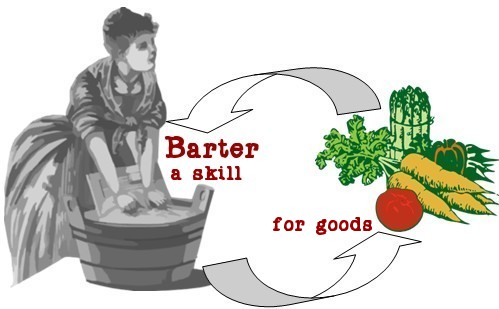
We were discussing Chapter 3 (Money - The Number Culture), which includes a brief history of money, from the days of barter through to today's banking databases.  One of the propositions of that chapter is that the barter of goods or services between two willing participants is always a win-win transaction.  Both sides are getting something they want, and either employing a skill that they already have or giving something that they want less - hence the net value of both sides goes up.  Such an exchange feels quite different when you instead look at two separate transactions that use money to quantify the value.


Barter actually capitalizes on the concept of marginal value.  This economics term is used to convey the idea that the 'value' of a particular thing (to us) depends on the quantity of that thing that we already have.  If I have hundreds of arrowheads, their marginal value to me is low, but if I have no baskets, the marginal value to me of a needed basket would be quite high.  I would be very willing to trade a few arrowheads for a basket.  Barter works when I find someone with many baskets (each therefore having a low marginal value for them), who needs an arrowhead or two.

So back to our story.  The reader who shared the anecdote is an organic hobby farmer of sorts.  She keeps a variety of livestock and is an enthusiastic promoter of permaculture practices.  As she relates it, she had an experience where the long hours of back-breaking farm work had taken its toll and she wanted to get a massage.  She had met a masseuse who was open to providing such a service in barter for some of the meat that the farmer raised on her land.  Learning that the typical price for the service was $80, she gathered up $80 worth of organic beef and went in for the relaxing treatment.

Alas, afterwards, she was disappointed by how she felt about the transaction.  Perhaps while in the midst of having the knots removed from her back, she was thinking about all the hours of work that had put them there: looking after her stock day after day, mucking out stalls, and hauling buckets of food for the grain-fed beef.  And, in exchange for a significant portion of the end gains, she was getting perhaps less than an hour on a massage table.  It didn't feel right.

This struck a chord with me.  In a later chapter (Ch. 5 - The Value of Time), I talk about how difficult it was for me, as a newly self-employed person, to set a billable value for my time.  I might do a day's work with community not-for-profits for $100, and then do the same work for a large corporation and bill more than ten times that amount.  So what was the true value of my time?  What should I bill clients who fell in between those extremes?  Was it right that the client's budget always determine my fee?  How could I determine if a particular project remuneration was "worth my time"?

My ultimate solution was how I felt about my contribution and corresponding compensation.  If I felt I was being taken advantage of (or was taking advantage of someone else) I felt bad.  Otherwise, I would consider the project a fair transaction.  The numbers played no direct role.  Now here was this woman voicing a familiar reaction:  the massage-for-beef transaction didn't feel right.  But this was barter!  So what went wrong?

Most people initially see the disconnect in terms of the time differences.  Farmers work long hard hours to grow, maintain, harvest, and prepare their produce for consumption.  And here was my friend, trading a chunk of that for a service that was provided in a tiny fraction of that time.  I agree that this would certainly be an influence.  However, quantifying time and worth is full of all kinds of pitfalls.  There are so many added variables.  A dentist charges not just for the half-hour of teeth work, but also the training, capital costs of the office, etc.  Part of a masseuse's fee has to take into account that they don't usually work full 8-hour days.  Nor can they leverage economies-of-scale to massage more than one client at a time, the way a farmer might be able to double their herd with minimal additional effort and overhead.

No, upon reflection, I think something much more interesting happened to this transaction.  The clue is the $80 value.  The reader had looked up the posted value of the massage and then tried to put together a package of food that had the same monetary value.  To me, that is not really barter.  That is simply a transaction, using prices on both sides, that happens to use meat as a currency.  Marginal value was no longer a key component of the feelings of value and worth.  Instead, both players reverted to the quantified market value, which completely alters the quality of the relationship.  As soon as the numbers come in, the barter doesn't even have to take place for the farmer to feel disappointed.  She could simply contemplate how she had just paid $80 for a massage and then later think about how much work had gone into a totally separate sale of $80 worth of beef.

That's the thing about numbers and number-based values.  They allow us to do things like instantly compare our salary to that of our spouse or a co-worker or a professional baseball player.  Or compare a season of livestock management to a spa treatment.  Such pursuits often to lead to bad feelings, no?

Friday, January 29, 2016

When are numbers bad?

Two years ago, I wrote a post about SMART goals, wondering whether society had developed a predilection to dismiss any goals or efforts that are not measurable.  I defended such immeasurable goals as being perfectly valid.  Then last week, a participant in our chapter-by-chapter exploration of The Value Crisis, asked if we should actually avoid SMART goals because they were number-based.  This is a common musing among readers: Is the book saying that numbers are bad?


The question highlights a distinction that cannot be over-emphasized:

Numbers are great.  It is our reliance on Number-Based Values that I question.

To answer the query that was raised at the meeting, there is nothing wrong with SMART goals.  If you can define a goal numerically, then it makes total sense to measure (and celebrate) your progress towards that goal.  If you choose to save $5,000 for a two-month vacation next year, I don't find any fault with that particular example of value-based decision-making.  Such a goal is not a demonstration of number-based values.  Why not?  Because we have not defined a situation in which more is always worth more.

On the contrary, the ultimate goal is quite specific: taking a two-month vacation.  The money is simply a means to an end.  Furthermore, the very nature of a properly formulated SMART goal is that it should incorporate a specific target, which can (and should) be interpreted as a definition of sufficiency.

Contrast this with a SMART goal that sets an objective of saving $10,000 more every year.  Now we are beginning to cross over the line.  A goal phrased in this way has milestones but no specific endpoint.  The money is no longer the means to an end - it has become the end in itself.  And we have made the tacit assumption that more money is always worth more.  That's true in a monetary (number-based) value system, but is it true when it comes to our quality of life?  Well, that's the $64,000 question, isn't it?

This is not an easy distinction to make.  As the discussion progressed, another participant asked if it was therefore more acceptable to set a specific dollar goal for money to be saved for your retirement (say $1,000,000) as opposed to setting a goal of a specific level of annual growth for your retirement investments (like 4%, for example).  Yes, there are probably subtle differences between the two goals, but I prefer to look at the bigger picture.  Is your overall goal really to have a certain amount of money when you retire, or should you be trying to define a certain quality of life that you hope to be enjoying when that day comes?

Better yet, perhaps you should be looking at the overall concepts of work and retirement.  That inquiry might involve examining your quality of life before your 65th birthday.  How many of us devote decades of our lives struggling at jobs that we consider onerous, with the major aim of better enjoying life when (and if) we reach a retirement age?  How many youth make life-altering career decisions solely on the basis of how much money they might make for the next four or five decades?

In The Value Crisis, I tell the story of how I observed folks in the previous generation 'retiring' but still working, and I asked them to define what retirement really meant for them.  It meant that they didn't have to work the same hours, but could choose to.  They stopped doing work that didn't interest them, and created understandings where they could take time off to enjoy a new project if an opportunity came up.  They avoided long-term work commitments and gave greater respect to their lives away from work  Why would anyone wait until they were in their 60's to take that approach to life?

So, working from that definition, I declared myself 'retired' before I was 40.  It doesn't mean I don't have to earn money any more - of course I do.  But it gave me a whole new outlook on how much I need (or don't), and what I am willing to do to get it.  My standard of living has gone down since then, but my quality of life has gone up.  A smart goal?  Well, for the most part, it's worked for me.

Sunday, January 24, 2016

The Moral Case for Alex Epstein

A Review of The Moral Case for FossilFuels, Alex Epstein (2014, 256 pages), as published in Alternatives Journal, December, 2015, by Andrew Welch.

Alex Epstein wants to shake up the way that we think about fossil fuels and challenge what behaviours we consider moral and immoral.  In his book The Moral Case for Fossil Fuels, he proposes reframing the conflict of environmentalists versus the hydrocarbon industry.  It’s not a question of fossil fuel usage being good or bad – it’s a question of what standard of value we are using to judge it.  I agree.


The author is a self-labeled humanist – a term he uses to describe someone who “treats the rest of nature as something to use for his benefit; the nonhumanist treats the rest of nature as something that must be served.”  What may at first appear to be conceit actually makes sense if we look deep enough inside the value system of most humans.  He argues that we should all hold human life as our one and only standard of value.

I believe this is a must-read book for environmentalists and climate change activists, but it won’t be an easy read.  Firstly, it’s hard to read anything that contradicts your strongly-held beliefs; however, questioning those beliefs is essential to gaining a truly balanced perspective.  Secondly, Epstein clearly targets an audience on the totally opposite end of the spectrum, opening with ‘proving’ that all the so-called ‘experts’ preaching the supposed detrimental impacts of rampant fossil fuel consumption are dead wrong and always have been.  (The ironic single-quotes and sneering italics are his frequent literary devices, not mine.)  Thirdly, although he conveniently lists the most common logical fallacies that surface in this debate, he happily (and frustratingly) employs each one in his own arguments.

Epstein is a practical philosopher and that’s where he shines.  He’s not a scientist, and when he attempts to take on science, his misuse and misrepresentation of statistics and data is unmistakable and shoddy.  Like every other non-scientist (and, sadly, some scientists) he chooses policy-based evidence over evidence-based policy.  To be fair, it’s a habit all humans have: being blind to evidence that contradicts our beliefs.  Furthermore, he does also present facts that many activists choose not to see.  However, he’s also happy to make up his own, such as “if there is no equal or superior alternative, then any government action against fossil fuels … is a guaranteed early death sentence for billions.”

The book is highly critical of mainstream thought leaders because they’re always preaching the costs of fossil fuels and never the benefits.  This is quite true, and while the reason might be not so much a bias as a tacit acceptance that such benefits go without saying, if we don’t consciously consider them, it may well skew our perspective.  Fossil fuels have made near-miraculous contributions to our standard of living in the last two centuries, and anyone who says we should stop using them needs to have their arguments seriously questioned.  Fair enough.

Accepting that there are errors and bias on both sides, I’d rather review the essence of his argument – that being, in his words:  “Mankind’s use of fossil fuels is supremely virtuous – because human life is the standard of value, and because using fossil fuels transforms our environment to make it wonderful for human life.”  And consequently, we should burn more, not less.

The problem is the standard he has chosen to judge our morality as a species.  He may be a humanist, but his goodness indicators are entirely quantitative measures:  More people, living more years, earning more money, to buy more stuff – all good.  For example, the only scale he uses (repeatedly) to measure safety is number of deaths (including life expectancy and infant mortality) – never health.  Happiness?  Quality of life versus standard of living?  Those he avoids entirely.  By his singular measure of success, a planet with 120 billion extravagant consumers, living 150 years each should be a stunningly better place for all (all humans, that is).  It’s a deeply-flawed more-is-always-better approach for an author who claims to be writing about morality.

In The Moral Case for Fossil Fuels, Alex Epstein reframes the fossil fuel debate correctly (as a value question), but, with Ayn Rand as his muse, he employs a highly questionable perspective for his big picture: ethical egoism.  Still, I think this book should be on every environmentalist’s bookshelf, if for no other reason than Stephen Covey’s "Seek first to understand, then to be understood."

Wednesday, January 20, 2016

Exploring The Value Crisis Chapter-by-Chapter

This post is a bit of a departure from the blog theme.  Consider it an introduction to the next series of postings (I hope).

I was very excited to see that The ValueCrisis is quite popular with book clubs – even clubs that normally only do fiction.  It seems that readers want to talk about this book with their peers.  That was definitely one of my hoped-for outcomes when writing it.

However, it turns out that some readers wanted to go even further.  A few months ago, two different book clubs (who had already done The Value Crisis as part of their regular gatherings) approached me in the very same week and asked if it might be possible to create a special club that explored the book as one chapter per meeting.

I was ecstatic!  Not only did this indicate an obvious interest in the subject matter, but I had sat in on a few gathering nights when clubs were discussing my book, and they often talked about the same things.  I wanted to know what they thought about other chapters, but I was also determined to shut up, listen carefully, and take notes on whatever they chose to talk about.  Here, at last, might be an opportunity to explore every nook and cranny.

The Caledon Public Library was quite receptive to this very novel idea (no pun intended), and announced The ValueCrisis discussion series as a new program, exploring a different chapter every two weeks.


Our first meeting was on January 12, 2016.  The weather was a bit dicey and I got calls from four people who had intended to come but were not going to be able to attend the first gathering.  Consequently, I was expecting a small crowd, but the big table ended up with 20 people sitting around it.  We never set a maximum for the series, but if we had, that would probably have been it.  We had a great introductory discussion, and some excellent refreshments!  I hope to have the same at every meeting.

So, the next few blog postings will be inspired by these chapter-by-chapter meetings.  Who knows, I may also get enough detailed feedback that I might attempt a second edition of the book, with clarifications, a stronger message, and updated anecdotes.

Please feel free to join us for any meeting, or contact me about starting a group in your area.