Tuesday, November 22, 2022

#2 - The Law of Negative Feedback

 (This is the third of a nine-part installment, offering a fresh new perspective on Climate Change.  For the big picture summary, see Turning Climate Change on its Head.)

Exponential growth and non-stop resource depletion are entirely unsustainable on a finite planet.  Nature controls for these imperatives by providing negative feedback mechanisms.  Evolution balances these two forces.  However, if the negative feedback is too great, the species will disappear.  On the other hand, the negative feedback can’t fail, because if it did, the unsustainability of exponential growth will be its own demise - it’s the ultimate negative feedback.
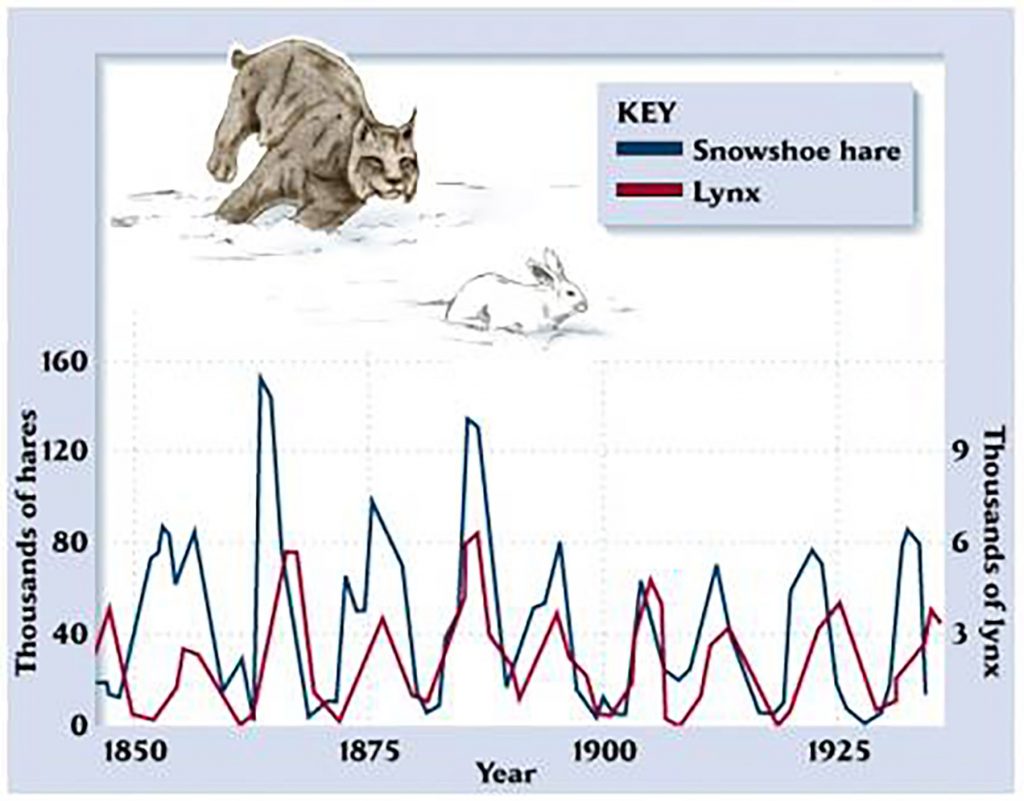

Evidence of hare and lynx population cycles

In part 2 (The Law of Propagation and Consumption), we established that, in the absence of counter-balancing forces, every living species would theoretically experience exponential growth.  The reality is that this does not happen in nature.  Populations grow and decline, often in somewhat predictable cycles.  Sometimes a population will decline to the point where a species will go extinct, but it has never been the case that a population's growth has continued unchecked to the point where it is occupying every square inch of the planet, crowding out every other living thing. 

Evolution is a remarkable, self-regulating process, operating in an environment of interconnected systems, whose complexity far exceeds our capacity to fully understand it.  One of the key attributes that evolution has created is a system of negative feedbacks that provide the counter-balancing force to population growth, referred to above.  If we can accept that no species is programmed to control its own population numbers, then this proves that something is controlling that exponential growth.  (Even if a species could be shown to be controlling its own numbers, would that not be evidence of nature giving them negative feedback that they were reacting to?)

We can demonstrate the presence of negative feedback by examining the three possible outcomes of a species population growth:

(a)  Extinction

The population declines permanently to zero.  As mentioned above, this would be evidence of negative feedback going too far, driving a species to extinction.  You may wonder why this does not happen very often.  (In the natural world, with no human interference, the extinction rate is estimated to be between 0.1 and 1 per million species per year).  The explanation is that nature's systems and cycles have been adjusting and fine-tuning themselves over millennia.  In the absence of rare, catastrophic events (e.g. a meteor impact), if the systems did not support the eventual restoration of any given species population, that species would have already disappeared a long time ago.

(b)  Steady population or cycle

Maintaining any living organisms (be they animal, plant, or microscopic) at a precise and constant population number would require a direct oversight that would be out of place in our natural world.  It is easier to accept that biology's intrinsic system designs merely react to the numbers going up or down in such a way that balance is eventually restored.

In the image shown at top, evidence of lynx and snowshoe hare populations in Canada's North over nearly a century was derived from the fur trading logbooks of the Hudson's Bay Company.  What we see is that as hare populations increased, the lynx numbers soon followed.  This is because the snowshoe hare is a common food for the lynx; a greater number of hares mean that a greater number of lynx remain healthy and survive the winter.  Following its own innate propagation programming, more lynx also means more having offspring that will also be feeding on the hares.  Eventually, the hare numbers begin to go down as they are eaten by the growing lynx population.  As soon as the hare numbers drop, so do the lynx numbers, as their food source disappears.  Of course, the lynx/hare pairing is not an isolated system.  Hare populations will also go up and down in relation to their own food sources and how many hares have to compete for that sustenance.

Limited food supply, which becomes scarcer as the consuming population rises, is one of the most common examples of nature's negative feedback mechanisms.  Another is susceptibility to disease due to increased population density.  Note how both mechanisms intrinsically become more effective as the population numbers increase - that's how negative feedback works.

(c)  Uncontrolled growth

All life, as we know it, requires energy consumption and habitat space.  If we presume it possible for any given species to increase in number without end, then the available energy and space would also have to be unlimited.  Neither is true on this finite planet.  Therefore, even if you could imagine a species that was able to circumvent every possible negative feedback mechanism thrown at it by nature (i.e unlimited food supplies, no increased susceptibility to disease, unlimited energy, etc.), that population would sooner or later hit the natural limits of energy and space on a finite planet.  In this case, you could think of those limits as being the ultimate negative feedback.

Astute readers will notice that humans seem very close to being examples of this third possible outcome.  They have adapted to life on every possible environment of the planet, managed their own food sources, cured diseases and increased life expectancies, found new energy sources, and (some might say) are even poised to colonize other planets.  I consider this an illusion, and we'll discuss this next in part 4 (The Myth of Self-Control and Immunity).

Conclusion

Looking at the three possible outcomes, I suggest that, from the collective perspective of any given species, the most desirable outcome is the second one, where nature uses negative feedback to manage the innate growth of their population to levels which can be sustained for many, many generations, evolving as time and other factors permit.  In other words, if we accept the first Law of Propagation and Consumption, then negative feedback is necessary for sustainable species existence.

(Continue to part 4 of 9)

Sunday, November 20, 2022

#1 - The Law of Propagation and Consumption

(This is the second of a nine-part installment, offering a fresh new perspective on Climate Change.  For the big picture summary, see Turning Climate Change on its Head.)

All living species are programmed at their core to propagate and make maximum use of available resources.  Evolution has consistently selected for these properties.  When these biological imperatives are unchecked, they lead inevitably to exponential growth and resource depletion.

Aerial view of Cairo, Egypt

Propagation

There is not a single living species, animal, plant, or microscopic, that has not been programmed for propagation of its species.  If it were otherwise, that species would have disappeared thousands of years ago.  I think we can confidently assign the term "Law" to this fact.

From a statistical perspective, we can also state emphatically that the average basic reproduction number, or R0 ("R-zero" - a term we got to know during the CoViD-19 pandemic) has to have been 1 or more.  That means for the average population of a given species, they are producing at least the same number of progeny - and typically, many more.  If they are not, or their progeny are not surviving until they are reproductive themselves, then that species population will be in decline and, again, will eventually disappear.

Death is a fact of life, and for reasons that we will explore more thoroughly in part 3 (The Law of Negative Feedback), we know it to be the case that not every individual in a given species population will survive long enough to produce a replacement progeny.  For that reason, it is almost always the case that the average number of offspring it has will be greater than 1.  In the animal kingdom one of the most prolific species has to be the seahorse, which has about 2000 offspring with every successful mating.  In the plant world, trees can produce tens of thousands of seeds - each with the potential to grow into a mature tree.

Let's consider what would happen if the basic reproduction number is greater than 1, and ALL progenies were to survive to reproductive maturity.  Firstly, the population will grow, obviously.  Eventually, it will double in size.  And then double again.  And again.  By immutable mathematics, this growth will be exponential.  In other words, the growth will not be a straight-line increase.  On top of the population increase, the number of additional progenies in every generation will itself increase, producing a curve that will slope ever more vertically. 

Consumption

The second part of the proposed law - that every species makes maximum use of available resources - is less necessary to my final conclusion.  Still, even though the proof may not be as empirical as for the first, every piece of anecdotal evidence available to us suggests that the second part is also true enough.

It is safe to say that all life, as we know it, needs to consume at least a bare minimum of resources in order to survive to reproductive maturity.  If the consumption of any given resource would be to the organism's advantage - especially if it would further the goal of propagation, there is no species that consistently and consciously makes its own decision to conserve resources instead of consuming them.  And if the population is growing, that survival imperative of that species will drive it to consume all available resources, as needed.

If you combine the consumption of at least a fixed minimum of resources with a population experiencing exponential growth, then the overall consumption of resources will also be growing at an exponential rate.  If these resources are not being replaced at the same rate at which they are consumed, then the species will, once again, eventually disappear.  Since the amount of energy and raw materials on a finite planet can be considered fixed, exponential growth of resources is unsustainable.

What about Humans?

Of course, it is very tempting to think of humans as an exception to the Law of Propagation and Consumption.  Certainly, as individuals, we seem to have acquired sufficient self-awareness and power to eschew propagation and control consumption - at least to a survival minimum.  However, overall, I believe this exceptionality to be a myth - one that we will address in part 4 (The Myth of Self-Control and Immunity) - but first, let's consider how nature typically manages population growth in part 3 (The Law of Negative Feedback).

(Continue to part 3 of 9)


Thursday, November 17, 2022

Turning Climate Change on its Head


Inspired by the work of Bill Rees (video), David Korten, and other thought leaders, I am moved to present a clear chain of thought, in six steps, leading inescapably (for me) to a surprising conclusion about Climate Change.  If widely accepted, this would turn the Climate Change Movement on its head.  I don't kid myself that this blog will have the viral impact needed to inspire real change, however, I challenge you, the reader, to choose any of the steps below and show me where my conclusion is problematic.

I present all six in summary here and have prepared a separate blog entry for each one, going into details and more explicitly presenting my case for the validity of my surprising conclusion.

#1 - The Law of Propagation and Consumption

All living species are programmed at their core to propagate and make maximum use of available resources.  Evolution has consistently selected for these properties.  When these biological imperatives are unchecked, they lead inevitably to exponential growth and resource depletion.  (Read more)

#2 - The Law of Negative Feedback

Paradoxically, exponential growth and non-stop resource depletion are entirely unsustainable on a finite planet.  Nature controls for these imperatives by providing negative feedback mechanisms.  Evolution balances these two forces.  However, if the negative feedback is too great, the species will disappear.  On the other hand, the negative feedback can’t fail, because if it did, the unsustainability of exponential growth will be its own demise - it’s the ultimate negative feedback. (Read more)

#3 - The Myth of Self-Control and Immunity

Humans are unlike any other species in the knowable history of our planet.  Our self-consciousness and incredible mastery of knowledge and collaboration collectively power a myth that the first two laws don't apply to us - that we can control our propagation and resource consumption, and that we are immune from nature’s feedback mechanisms.  This turns out to be false under our current paradigm.  (Read more)

#4 - The Complex Crises of Current Reality

Human ingenuity and technology, combined with our unnatural quantitative value system (where More is Always Better), have ultimately led to multiple complex crises that directly threaten civilization as we know it.  They include climate change, the Sixth mass extinction, resource scarcity, global poisoning, food insecurity, pandemic diseases, uncontrolled technologies, nuclear arms, overpopulation, and untenable social inequity.  These have been collectively described as ecological overshoot.  While there is no question that these crises are connected, solving any one of them will not solve the others.  (Read more)

#5a - Impossibility of Effective Climate Change Action?

Either effective action to halt or mitigate climate change is possible, or it’s not.  Let’s consider both options, starting with the second.

Climate Change is already well underway.  There’s a belief that what’s needed is serious political or corporate will, but I suggest the reality is that our predominant societal value system simply cannot accommodate the required actions.  If we also accept the inevitability of the law of consumption, and the fact that immunity from consequences is a myth, climate change WILL be in our future.  (Read more)

#5b - Consequences of Effective Climate Change Action?

It’s even more interesting when we explore what happens if halting or mitigating climate change IS possible - and we do it.  Yes, the effort would be huge beyond belief, but imagine we could actually do it.  So what about the other complex crises currently looming over us?  Even if effective action on Climate Change were possible, we are still subject to all the other crises.  Indeed, while solving Climate Change would probably help with some of them (e.g. the Sixth mass extinction and food insecurity), it would merely allow every other complex crisis - the ones without the present stature and focus of Climate Change - to worsen.  We'd be putting society back on track to its own destruction!  (Read more)

#6 - The Conclusion for an Altered Perception of Climate Change

Putting all of the preceding Laws, Myth, Reality, and Possibilities together, I propose the following conclusion:

Climate Change is negative feedback that nature is imposing on our exponential growth and out-of-control consumption.  As awful as it will be, that negative feedback shuts down our suicidal behaviours and gives us precisely the opportunity we need right now to survive into the distant future.  Climate Change is therefore a critical part of the solution for the continuance of the human species - a force strong enough to cause us to question our value systems and change course with whatever is left of civilization.

(Read more) 

Of course, the obvious cap to all of this is a ninth post, being A Discussion of Our Best Strategy Right Now.


Wednesday, March 16, 2022

The Environmentalist's Case Against Basic Income

At a recent talk that I was giving about my second book, Our Second Chance, I was sharing my supportive views on the concept of Basic Incomes.  Afterwards, I was reviewing the valuable comments in the Chat room, and found this gem:

"Futurist Douglas Rushkoff had espoused UBI (Universal Basic Income) in two of his books, but has since retracted his endorsement of the idea as he had come to realize that UBI without a deeper paradigm shift will only amount to increasing the rate of extraction, exploitation and consumption of earth's resources.  This is Douglas Rushkoff describing his rationale for no longer supporting the concept of UBI here."

The first 10:30 of the linked podcast is a monologue in which Rushkoff outlines his serious reservations with a Basic Income scheme - namely that it merely amplifies the population's role as consumers. Giving money to the people at the bottom will not create economic justice, he says, since that money will simply pay for increased consumption, thereby (a) continuing to line the pockets of the upper echelon capitalists, and (b) making our resource extraction and environmental degradation even worse.

Knowing that Rushkoff, a well-respected author, was changing his tune on Basic Income, led me to give his new position very careful consideration.  It is indeed a worrying proposition.  We all know that any attempt to raise the overall standard of living for a large number of people will entail a greater consumption of planetary resources - at least in the short-term.  Does that mean we are doomed to choose between widespread social inequity versus resource destruction?

Changing the Rules

Let me first say that I am very much in agreement with his fundamental objective.  In the podcast, he phrased the big picture in this way:

"It's not too late for us to start companies, cooperatives, commons where we all, everyone, owns a stake in the thing.  And then we can change our role in the economy from mere consumers to stakeholders; our role in society from consumers to citizens; and our role with each other from competitors to partners.  Now, the only substantive change we can make to our economic operating system is to distribute ownership, control, and governance of the real world to the people who live in it."

Well said!  I also agree that reinforcing the consumer tendencies of those close to or below the poverty line in our society actually channels that money to those at the top - seemingly defeating the purpose.

However, my Zoom audience member qualified Rushkoff's position more than the podcast does:  A UBI without a deeper paradigm shift, is problematic.  Well of course it is!  But a Basic Income is the best first step to achieving that paradigm shift!

I propose that, as living creatures, we are all consumers, citizens, and stakeholders (investors).  Those are the three value personae that I work from in my books (with a nod to Robert Reich).  We cannot eliminate the Consumer persona - all living creatures must consume.  A Guaranteed Basic Income (GBI) model simply says that consumption needed for survival should be free - a basic human right, based on the abundance that we now enjoy.

I confess that I don't know all of Rushkoff's reasons for turning his back on Basic Incomes, but here are my reactions to what he said in his ten-and-a-half-minute monologue:

1.  A Grand Destination with no Road Map

The proposal that he makes for a new world, with distributed ownership, control, and governance is a wonderful ideal, but that change cannot be wished or even legislated into being.  There must first be a fundamental shift in our value systems and economic models.  The real change must (most likely) come from the bottom up - from the vast swath of consumers - and to do that, you have to first release them from slavery.

(I use the term "slavery" advisedly.  Our current economic model says that, for the overwhelming majority of people, we need income and a job in order to meet our basic survival needs.  Take our job away and we are homeless, hungry, and - if the social safety nets are overwhelmed - dead.  The choice of "to work or to die" is essentially slavery.)

Basic Income is the most fundamental shift in our economic model that currently has a chance of actually being enacted,  The U.S. was two Senate votes shy of a basic income model 50 years ago.  It currently has broad support across the entire political spectrum.  The CoViD-19 pandemic did wonders for showing the general public how the basic principle might work.  A Basic Income is the best first step on the road map to the changes Rushkoff seeks.

2.  The Asset Alternative

I like the idea he mentions of giving people assets instead of income.  Unfortunately, it's not very clear what he means by "assets".  It seems impractical (and demeaning) to give people food instead of the money to buy food.  If you give them other assets, and don't change the paradigm of "money equals survival", those assets will soon be sold and you will be worse off than before.  Again, I agree with the principle of a lot more common wealth.  I don't think land or natural resources should be ownable.  But just giving away assets (if one could even do that), without rethinking the nature of ownership, does not solve the problem.

3.  Beyond the Poverty Line

Contrary to what Rushkoff says in his monologue (and contrary to common belief), UBI is not just a way to take poverty off the table.  A Basic Income alters the way everyone thinks about the future.  It impacts the non-wage-earner in an abusive relationship, the worker replaced by automation, the entrepreneur, the career-changer, the lifetime volunteer, and the new Art graduate (the one that he says usually has to go straight into a job because they can't afford a studio).  People can take risks, get better jobs, and invest in their future because their basic survival is not on the line.  Basic Income is a psychological gamechanger.  And that's what his operating system change calls for - a psychological gamechanger.  It can't happen with anything less.

4.  Follow the Money

I think he oversimplifies the flow of money when he says that the poor consumers will simply give their Basic Income cheque over to the capitalists.  I see the Basic Income scenario as including four major differences from the status quo:

(A)  We already hand out billions in social assistance.  A GBI merely gives that money out without all of the cumbersome application, eligibility, and ongoing oversight costs.  A lot of the money that would be going to those at the bottom of the pyramid is already being doled out.

(B)  In order for governments to afford these programs, they have to stop giving out the other billions of dollars in subsidies and incentives at the top.  They also have to revise tax laws and enforcement to reduce the wealth being stashed away at the highest echelons.  There are counterbalancing factors.  So even if the money eventually goes back to the 1%, it is doing people good on the way, instead of going straight into a corporate profit account.

(C)  The big picture when you level the playing field for the lower and middle classes is that entrepreneurship is increased.  Populations can afford to support local business, and finally have the option of choosing quality over the cheapest survival option.  Many shop at Walmart because that's all they can afford and they measure value by number.  A GBI has the potential to alter how we view money - as a tool rather than a survival imperative.  That paradigm shift will necessarily impact the monolithic corporations more than anything else.

(D)  Rushkoff portrays Basic Income as a very simple circle of money going from the government to the poor and then straight to the corporations.  This suggests that the status quo is preferable because when people can't afford to eat or put a roof over their heads... well, at least the billionaires aren't taking that money.  That is a pretty sad justification.  And if it's true, then where does that same money go now?  Do the governments keep it?  No, it participates in a different cycle, which is...

5. The Economic Growth Conundrum

The richest people in society profit from economic growth.  Economic growth is needed largely to create jobs and income so that we can have economic growth.  It is a vicious circle where those at the top reap the greatest benefit.  We have been told that jobs are good because everyone needs one in order to perpetuate and expand consumption.

We also know that when more money moves around (as would be the case with a GBI), you get serious economic growth - and thus, more of what is damaging the planet.  And yet, I believe that such a cycle is fundamentally different.  When millions of people don't need a job just to survive, they can choose more meaningful occupations.  We don't need to create bullshit jobs just to keep people busy and paid so that they can eat.  A GBI allows people to reconsider what is important to them, and returns consumption to a simple survival imperative instead of an economic one.  It makes it possible for an environmentally sustainable cycle to emerge.


In summary, I think Douglas Rushkoff is correct that a Basic Income, on its own, is not going to solve our flawed economic model.  Yet, I don't think that solution should ever stop there.  A GBI is merely the first game-changing step in a massive paradigm shift about how we value people and what is important to us as a species and as a society.  Yes, the digital behemoths have to be broken up and we have to re-write the myth of commercial corporations.  Yes, we need to reduce our role as consumer, and increase our stakeholder and citizen values.  And yes, we need to revisit asset ownership, control, and governance.

I am convinced that the best and most likely path to making all of that a reality is to change how we think about money and survival, and the most practical, realistic, and currently relevant way of doing that is with a Basic Income.

Friday, February 19, 2021

Basic Income - Where Does the Money Come From?

Believe it or not, back in the 1970s, President Nixon's administration was a heartbeat away from instituting what was effectively a Guaranteed Basic Income (GBI) program for the entire United States (before a few individuals derailed the plan). Today, with 2020 hindsight, everyone is realizing that a Universal Basic Income (UBI) would have been the best possible solution to the CoViD-19 economic crisis. The impact of our global pandemic has thus contributed to a renewed awareness of the power of Basic Income schemes, and many people are now pushing for those programs to be revisited.

The concept of a Basic Income for an entire population raises a lot of questions, but the most prevalent is this one:

Where is the money going to come from?


I believe this is a misleading question. The equivalent, for me, is hearing on the radio that a very significant rainfall is forecast and asking where all that water is going to come from. There won't suddenly be less water in your taps or in your well.  Your cistern won't suddenly be depleted. Nor will the lakes and reservoirs go down - in fact, their water level will obviously rise.

Water is necessary for life, just like money is now necessary for today's economy.  But plants and animals don't really consume water - they use it. Water facilitates the processes of life. Water moves in a cycle, and if that cycle were to stop, all life would soon end.

Money is exactly the same. We don't consume money - we use it. Money facilitates the processes of economic transactions. Money has to move in a cycle, and if that cycle were to stop, all economic activity would soon end. (That's what happened in the Great Depression: money stopped moving.)

One of the key concepts to be grasped for basic income programs is that "income" is not the same as "wealth". When we imagine the government handing out cheques to the population every month, it is a mistake to only consider that step of the cycle and wonder where all that money is going to come from. When money goes to people who really need it, that cash does not get added to Wealth - it gets spent. To use the water metaphor, only rich people have huge reservoirs and sealed aquifers that trap water and don't allow it to flow (wealth). Money, for everyone else, moves as streams and rivers, flowing out so that goods and services can flow in.

Here's how the simplified money cycle looks (to me):


The green lines show the cycles of money. The blue lines are also money (and luxury assets), that represent the discretionary transfers to and from Producers or Consumers that have a stockpile of Wealth.  (Other than bringing in money from Wealth and injecting it into the money cycle, retained Wealth is not part of the flow.) The red lines represent the flow of Goods and Services (materials and energy) - I include them just for completeness.

The major flow of money in our present economy is made up of Purchases and Wages. Both of those flows are Taxed so that the Government can meet society's Infrastructure needs. If you introduce a Basic Income, that money does not get added to Wealth (where it can pool and stagnate) - it gets immediately injected into the monetary flow, increasing economic activity. Purchases go up, demand goes up, production goes up, tax revenue increases correspondingly, and the cycle continues. Taxation is like evaporation - the money/water doesn't disappear; it simply reloads the system!

[NOTE: For those who hate Taxation and call for less Government, it is true that the cycle would still work with nothing in the centre, but the main green circle would soon get smaller, and (since the Producers would control the Natural Resources) the blue arrow on the right would effectively disappear.]

Basic income programs do not reduce the number of people willing to work, any more than rainfall results in plants not growing roots, but a guaranteed living allowance does reduce their dependence on dead-end jobs. (In other words, a GBI eliminates the slavery imperative: find a job or starve.) Over time, a GBI can also facilitate increased automation and shorter work weeks for all.

When the system is in balance, there will be dramatically decreased welfare supplements (which are like costly irrigation systems in areas with no rainfall), lower infrastructure costs (due to better health and lower crime rates), less stress for everyone's future, and a higher quality of life for all citizens. And yes, with all of that extra activity, it is possible that a higher Tax rate on Wealth might be necessary just to keep the revved-up cycle from being entirely diverted into the private reservoirs of the billionaires. Remember, they are not creating the jobs or driving the economy any more (if they ever were) - it's the Basic Income that's now doing that.

A Basic Income program does not demand that a nation have more money - it just moves a lot more of it around, and redistributes the flows in such a way that benefits everyone. (Read about its impact on me, for example.)

Saturday, June 20, 2020

"Gift Economy" is Misleading

There are a growing number of proponents of a gift economy as being a desirable alternative to our status quo monetary economy.  According to Wikipedia:
"a gift economy or gift culture is a mode of exchange where valuables are not traded or sold, but rather given without an explicit agreement for immediate or future rewards."

I like the concept of gift economies and I fully appreciate the advantages that they convey.  However, it is difficult to find modern examples of viable gift economies that make any sense.  Most examples of gift cultures are dated and decidedly anthropological.  Such ideals are never going to be broadly adopted so long as people believe that the alternative to an economic life where you simply buy things with money is an economy where everything is given for free - that is entirely impractical and quite impossible for people to wrap their heads around.

One also finds that more pragmatic descriptions of alternative economic systems go well beyond gifts.  I propose that gift economies are simply one manifestation of a much better alternative paradigm: qualitative economies.

What are Qualitative Economies?


My research is devoted to exploring the differences and consequential impacts of quantitative versus qualitative values.  A quantitative (or number-based) value system is one where, by definition, more is always worth more.  The modern status quo economy is a quantitative economy, in that it uses quantitative values (overwhelmingly, money) to measure its success.  A qualitative economy (a term which I'm essentially creating here) is one measured by qualitative values, such as satisfaction, product longevity and reliability, and the relationships formed between people.  (This is not to be confused with qualitative economics, which is apparently a term in quantitative theory when actual measurements are unavailable - a decidedly inferior appropriation of the term.)  Let's look at some examples:

Gifts - As I said, a gift economy is but one of multiple facets of qualitative economies.  Gifts create joy for both giver and recipient.  They also create desirable social obligations which strengthen human relationships, and furthermore motivate recipients to become givers to new recipients (as well as possibly reciprocating the original gift).

Pay-What-You-Choose - Some entrepreneurs and self-employed service providers prefer a less rigid form of transactions whereby the recipient of the service pays what they believe the service to be worth.  This opens up services to a wider market and allows compensation to be influenced by available wealth as well as quality of work, relationship, etc.  Variations on this model are more common than one might think.

Libraries/Sharing - These days, the term "libraries" extends beyond books into tools, seeds, bicycles, cars - any resources which are shared within a community at little or no charge.  (To be sure, it does NOT include Uber, AirBnB, and other access economy corporations that simply monetize your possessions and are the antithesis of sharing!)  Sharing can also include interest-free loans - money is not forbidden in qualitative economies.

Donations - Donations come in many forms, including volunteerism, charitable giving of funds, unwanted household items going to thrift shops, and even free or open source software.  Wikipedia, for example, is part of a qualitative economy, where many thousands of people donate time, knowledge, and editing skills in order to provide the resource free to everyone on the internet.

Refocused Traditional - For those who still struggle with the above examples, I maintain that simply by shifting the focus of value, one can achieve qualitative economics in what might appear to be a traditional monetary transaction.  The key is to emphasize qualitative values such as longevity, environmental friendliness, and aesthetics over price and market share.  Examples include one-of-a-kind craftsmanship, original artwork transactions, community-sponsored agriculture, and local economies which emphasize relationship over cost.

Barter - Because most barter is unique to each transaction and relationship, and barter is often a win-win where the value on both sides goes up, it could probably be included as yet another facet of a qualitative economy.  (One must take care that it does not get redefined in monetary terms.)

What Distinguishes Quantitative and Qualitative Economies?


Attributes
Quantitative Economy
Qualitative Economy
Value measured by:
Quantity – more is always worth more
Quality – longevity, aesthetics, relationship-building
Basis:
Dead relationship between items in transaction
Living relationship between people in transaction
Key to increasing value:
Scarcity, minimizing investment in individual items, ownership
Abundance, maximizing investment in individual items, sharing
Values after transfer:
Won & lost – zero-sum game
Win-win – transactions build value on both sides
Amounts ('price') determined by:
Seller/Receiver
Buyer/Giver
Motivations:
Enjoying the end result (but unreachable maximum)
Enjoying the journey (but not always positive)
Global measures:
GDP (Gross Domestic Product)
GWI (Genuine Wellness Index), or GNH (Gross National Happiness)
Examples:
Purchases, theft (note how theft fits all of the attributes in this column and none in the other)
Barter, gifts, pay-what-you-choose, donations, libraries, craftsmanship
Benefits:
Massive scalability, accelerated progress, easily mathematized
Sustainability, repairability, open source, satisfies human needs
Disadvantages:
Dissatisfaction, ecological destruction, proprietary
Slower, limited scope, trust-based
End results:
Objective comparisons, inequity, oppression, deception rewarded, monetize and consume global resources, dismissal of human values, race to the bottom
Subjective comparisons, cooperation, deception punished, honours interconnectedness of all things, promotes joy and well-being

In Summary


It should be clear that altering our perception of how our economies must work is not all about giving everything away, trusting in the inherent generosity of strangers, and singing Kumbaya around a communal campfire.  The advantages of qualitative economies are things that we all want: Quality, repairable, aesthetically-pleasing products, in abundance, and with joyful relationships.  And, perhaps most importantly, we don't have to replace our status quo monetary economies across the board.  It is entirely feasible and practical to have both styles of economic activity exist simultaneously within the same population - they do so now!

The key is to allow both value systems equal weight so that money does not always trump human qualities, and also to re-examine the role of single-track entities, such as commercial corporations, which are unable to operate in qualitative economies, and are thus incapable of being part of a balanced society.

Tuesday, June 9, 2020

The Left's Case Against Basic Income

One curious thing about calls for the government to introduce a Guaranteed Basic Income (GBI) for all citizens is that they come from all over the political spectrum, from the far left to the far right.  Most people express surprise that such a seemingly 'socialist' proposal can be supported by some ultra-conservatives, but once you grasp their thinking, it naturally follows that some progressive liberal thinkers are therefore (unexpectedly) opposed to the GBI concept.

I have selected an article that expresses this perspective, and gives a fairly comprehensive list of the objections from the left that I have seen.  I leave it to the reader to first review the article, and then we will try to formulate some kind of response to their concerns and counter-arguments:
A basic income would be a major concession to the capitalist takeover of everyday life  (by Nicholas Erwin-Longstaff, York University graduate student in labour geography)
Before we begin, it should be made clear whether Erwin-Longstaff was comparing a Basic Income system to the status quo, or to his preferable system of government-supplied necessities of life (a la Medicare).  Unfortunately, he does not make this clear , and his various objections seem to waver between the two.  I will attempt to do both comparisons.

I've broken down the primary concerns into three general topics:

Deep Cuts to Social Safety Net

This is perhaps the most easily refuted objection to implementing a GBI.  Erwin-Longstaff says there would be "deep cuts elsewhere in the social safety net, resulting in a deepening of government austerity".  The first part is not only expected - it's desirable.  The second part is absurd.

Could there be a more comprehensive social safety net than a GBI - a program that is available to everyone, at any time, no questions asked?  Realistically, no, there couldn't.  Would the existing social assistance programs be reduced, if not, in some cases, eliminated?  Yes - because they would no longer be needed to the same degree.  If, on the other hand, certain programs were still necessary for those in dire need, there is nothing to say that such programs could not be retained.  The arguments for keeping a particular program under a GBI would be exactly the same as the arguments for having it now.  To say that they would all automatically disappear once a GBI is in place is no different from the panic that they could all disappear tomorrow, even under the status quo.  A GBI is not going to cover every single dire need in our society, so we still have to provide for those situations.  However, a GBI would categorically reduce the need for the vast majority of our social welfare system, along with its administration, assessments, failings, etc.

To then complain that a GBI, where the government is giving a guaranteed subsistence income to every citizen who needs it, amounts to government austerity is ridiculous.  I have seen many ardent supporters of GBI programs, but not one has ever suggested that the government would be spending less on a GBI than it does now on existing social programs.  Giving every person an annual income with no strings attached is a very strange definition of government austerity.

Erwin-Longstaff also fears that the government would "whittle away even the most ambitious BI to a barely subsistence-level support".  Of course, this is a danger for any program implemented by any government using a status quo paradigm.  However, I think it reasonable to insist that any true GBI program has to be implemented very differently from the come-and-go social welfare systems that we create and modify now.  A GBI is a long-term total gamechanger.  The only way that it's going to be truly effective is if it's implemented in such a way that future governments cannot later pull the rug out or whittle it down.  (That's part of the "Guaranteed" in the name.)  Perhaps it even needs to be a Constitutional amendment.  (Yes, it is that significant.)

All that being said, the author is correct that Basic Income programs are not intended to replace all current social provisions, but I don't think they should be viewed as complementing them either.  GBIs simply take survival completely out of the realm of social assistance and even out of standard paycheques - for everyone.

One specific present-day program needs to be addressed here - subsidized daycare.  The author makes the pseudo-liberated assumption that all women should choose to be out their having their own job; that the modern-day necessity of two-income families in order to get by is something to be retained.  When it was noted that some GBI trial outcomes showed more women staying at home to raise children, he highlights the absurdity of this with sarcastic quotes: "women 'choosing'  to remain at home".  And yet the authenticity of that choice is the very essence of a GBI.  He fears the ceaseless pursuit of capitalist growth and profit, and yet he wants more people working to produce those very ends.

I get it:  If you remove subsidized daycare, it would at first appear that fewer families will have the easy choice to have two careers going while the kids are shuffled off to an institutionalized baby-sitting service. However, I tend to think in broader strokes.  With a GBI accessible to everyone, I believe that communities will have numerous and superior alternatives to subsidized daycare.  Subsidized daycare, to my mind, merely perpetuates educational and opportunity inequities when the wealthy will be using vastly superior services like in-home nannies, etc.  Let's be absolutely clear: a GBI increases options - for everyone.

Capitalism will Adjust Negatively

I can appreciate the fear that with a GBI in place, capitalism could then attempt to eradicate its effects by lowering wages and increasing prices.  And yet I fail to see how a GBI newly introduces either this possibility or the motivation behind it.  Erwin-Longstaff says: "a BI would leave people vulnerable to rising rents and prices".  So if there was no basic income, people would somehow not be vulnerable to these?  That makes no sense.  The objection is similar to saying "a pay raise leaves people vulnerable to rising rents and prices" - so we should abolish pay raises.  Ridiculous!

And while we're on that topic - a basic income is not  a pay raise or a wage subsidy; it is something completely different.  Employment and wages would still be there to allow one to set and maintain a standard of living, but they would no longer be the determinants of life or death.  Under a GBI, survival is free - it is a basic human right.

To say it again, a GBI, to my way of thinking, should not  be intended to directly lift everyone out of poverty.   The function of a GBI is to remove the question of having or not having the absolute necessities from the whole poverty/wealth equation.  For other things, there will still be haves and have-nots, but a GBI offers those at the bottom of the ladder what our current social welfare system absolutely does not: the opportunity to lift themselves out of poverty.

Philosophical Impact and Preferable Solutions

Another concern expressed in the referenced article is that a Basic Income program would "commodify all aspects of life".  In other words, under this revised paradigm, food and shelter would still be items bought and sold in a marketplace.  I can't argue with that.  Since this is obviously also the status quo, I presume Erwin-Longstaff is now switching gears and comparing a GBI to an entirely alternate solution - one which would "remove the need for cash altogether - reduce or eliminate the costs associated with other vital human needs, such as housing, education and care work".

That entirely socialist solution might indeed be preferable, but somehow I don't see it as having anything like the realistic opportunities that a GBI has for implementation.  The state handing out all food and shelter?  Not a very attractive near-future prospect.  Let's take things one giant leap at a time, please.

The author also points out that "expanding public services reliably pushes back against the logic of the market, whereas BI represents a deep concession to the ongoing capitalist takeover of every aspect of social life".  Again, there may well be advantages to radically altering how each one of us acquires what we need, and to the core definitions of ownership and commerce, but I don't think that we as a society have evolved to that possibility yet.  Indeed, I continue to argue that a GBI has the very opposite effect from the latter part of the concern expressed.  When everyone can access the necessities of life without having to sell their labour to the capitalist system, I would hardly call that advancing the capitalist takeover.  No, it is in actual fact a complete reversal of the extortionate stranglehold that the marketplace holds over practically every living human on the planet.

The article references another critic, John Clarke (writer and retired organizer for the Ontario Coalition Against Poverty), who wrote another contrary viewpoint in the context of the CoViD-19 pandemic.  As a bonus, I'll give the critics another shot at things:  The False Hope of a Pandemic Basic Income

Left-leaning critics of Basic Income programs seem to continually view the world using the glasses of the right.  They are understandably wary because we have always played by the right's rules, so our social programs have always been vulnerable to their tinkering.

I, on the other hand, believe Guaranteed Basic Income programs create a whole new playing field, and a very real opportunity for society to shift - perhaps even in the direction that those critics dream of.